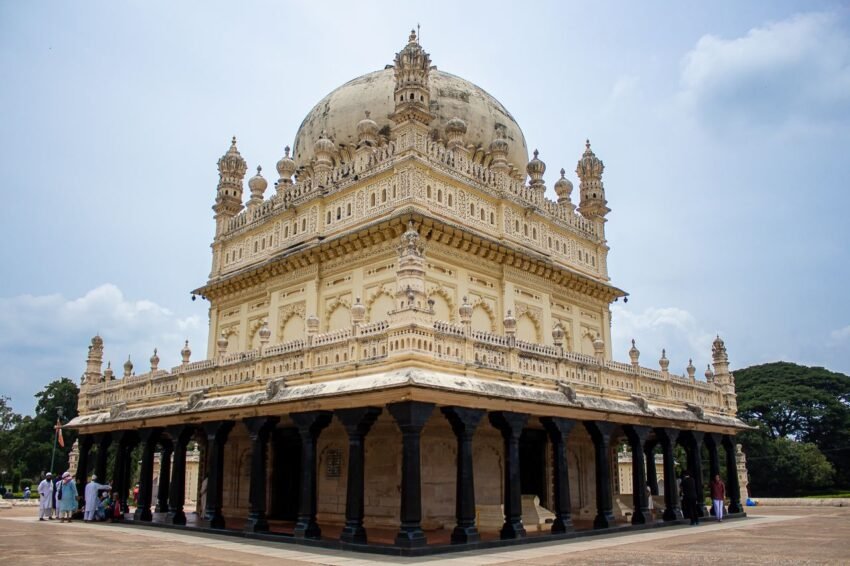
During the late 18th century, as the British East India Company (EIC) expanded its control across Bengal and the Carnatic, the Kingdom of Mysore emerged as its most formidable Indian military rival. Under the leadership of Hyder Ali and his son Tipu Sultan (the “Tiger of Mysore”), Mysore modernized its armed forces, forged strategic alliances with the French, and deployed innovative iron-cased rocket artillery that caught British commanders off guard.
Spanning three decades (1767–1799 CE), the four Anglo-Mysore Wars determined which power would dominate Southern India.
1. The Rise of Mysore: Hyder Ali and Military Modernization
Hyder Ali, a soldier who rose through the ranks of the Wodeyar army to become the de facto ruler of Mysore in 1761 CE, recognized European military tactics early. He established armories (Taraqhanas) across his kingdom and integrated French mercenaries to drill his infantry in modern discipline, flintlock muskets, and mobility.
                    THE RISE OF MYSORE'S MILITARY MACHINE
  +-------------------------------------------------------------------+
  | EUROPEAN MOBILIZATION                                             |
  | Hyder Ali builds an artillery corps & armories with French aid.   |
  +-------------------------------------------------------------------+
                                    |
                                    v
  +-------------------------------------------------------------------+
  | FIRST ANGLO-MYSORE WAR (1767-1769 CE)                             |
  | Mysore outmaneuvers British forces, marching to the gates of      |
  | Madras and forcing the EIC to sign a defensive alliance.          |
  +-------------------------------------------------------------------+
                                    |
                                    v
  +-------------------------------------------------------------------+
  | SECOND ANGLO-MYSORE WAR (1780-1784 CE)                            |
  | Mysore inflicts a crushing defeat on Colonel Baillie at Pollilur. |
  | Treaty of Mangalore signed; restores pre-war status quo.          |
  +-------------------------------------------------------------------+
During the Battle of Pollilur (1780 CE), Hyder Ali and young Tipu Sultan inflicted one of the worst defeats the East India Company ever suffered on Indian soil, capturing an entire British detachment under Colonel William Baillie.
2. Military Innovation: The Mysorean Iron Rockets
Mysore’s most notable technological achievement was the development of the Mysorean Rocket—the world’s first operational iron-cased military rocket artillery.
Mechanical Superiority Over European Artillery
While Asian and European armies had used soft paper-cased rockets for centuries, they lacked structural range and explosive yield. Hyder Ali and Tipu Sultan introduced a key engineering breakthrough:
-
Iron Combustion Chambers: Soft iron tubing held black powder at much higher pressures, increasing thrust and extending ranges up to 2 kilometers (over 1 mile).
-
Attached Sword Blades: Long bamboo poles acted as stabilizers, often fitted with sharp curved blades at the tips. When fired in salvos, the rockets destabilized enemy cavalry formations and detonated nearby powder wagons.
-
Specialized Rocket Corps (Jourd): Tipu Sultan organized dedicated rocket artillery units, growing the corps from 1,200 men under his father to over 5,000 specialized artillerists.
Following the fall of Mysore in 1799, captured Mysorean rockets were sent to the Royal Arsenal in Woolwich, England, directly inspiring William Congreve to develop the Congreve Rocket, which was later used by the British in the Napoleonic Wars and the War of 1812.
3. Tipu Sultan and the Geopolitical Struggle
Succeeding his father in 1782 CE during the Second Anglo-Mysore War, Tipu Sultan sought to build a global anti-British coalition. He sent diplomatic missions to Ottoman Istanbul, Zand Iran, and Revolutionary France (establishing contact with Napoleon Bonaparte).
The Final Clashes
-
Third Anglo-Mysore War (1790–1792 CE): Governor-General Lord Cornwallis formed a grand coalition combining British forces with the Maratha Empire and the Nizam of Hyderabad. Tipu was besieged at his island capital, Seringapatam, and forced to sign the Treaty of Seringapatam (1792), ceding half his territory and paying heavy war indemnities.
-
Fourth Anglo-Mysore War (1799 CE): Driven by concerns over Tipu’s correspondence with Napoleon, Governor-General Arthur Wellesley (later Duke of Wellington) launched a final invasion.
                 SIEGE OF SERINGAPATAM (MAY 4, 1799)
  ===================================================================
                       EAST INDIA COMPANY & ALLIES
             (Triple Alliance: EIC, Marathas, Nizam)
  ===================================================================
                                 |
                                 v
                       [ BREACH OF FORT WALLS ]
                                 |
                                 v
                 [ FALL OF MYSORE & DEATH OF TIPU ]
          (Tipu Sultan killed defending Water Gate breach)
4. Chronological Overview of the Four Wars
| War | Years | Primary Commanders | Major Outcome |
| First War | 1767–1769 | Hyder Ali vs. EIC Madras Command | Mysore Victory: Treaty of Madras signed under dictate. |
| Second War | 1780–1784 | Hyder Ali / Tipu Sultan vs. Eyre Coote | Draw: Treaty of Mangalore restores conquered lands. |
| Third War | 1790–1792 | Tipu Sultan vs. Lord Cornwallis | British Victory: Tipu cedes half his kingdom. |
| Fourth War | 1799 | Tipu Sultan vs. Arthur Wellesley | Decisive British Victory: Tipu killed; Wodeyars restored as puppet rulers. |
5. Historical Legacy
The defeat of Tipu Sultan in 1799 eliminated the last major state in Southern India capable of challenging the East India Company’s military power. The conquest granted the EIC complete supremacy over the Deccan peninsula and provided them with military technologies—most notably iron-cased rocket artillery—that influenced European warfare over the following century.
Category: History of India