In May 1857, a widespread uprising erupted across Northern and Central India, shaking the foundations of British colonial rule. Known variously as the Sepoy Mutiny, the Indian Mutiny, or the First War of Independence, the Indian Rebellion of 1857 was a major watershed in modern South Asian history.
What began as a military mutiny among Indian soldiers (sepoys) of the Bengal Native Infantry quickly evolved into a broad-based anti-colonial uprising uniting deposed royal families, dispossessed landowners, peasants, and religious leaders against the British East India Company (EIC).
1. Multi-Dimensional Causes of the Rebellion
The uprising was not an isolated incident but the climax of a century of economic exploitation, political annexation, and social interference following the Battle of Plassey (1757).
                      ROOT CAUSES OF THE 1857 UPRISING
  +-------------------------------------------------------------------+
  | POLITICAL & TERRITORIAL                                           |
  | Aggressive annexations via Lord Dalhousie's Doctrine of Lapse     |
  | (e.g., Satara, Jhansi, Nagpur) and the forced annexation of Awadh. |
  +-------------------------------------------------------------------+
                                    |
                                    v
  +-------------------------------------------------------------------+
  | ECONOMIC EXPLOITATION                                             |
  | High land revenue demands, destruction of traditional Indian      |
  | handicrafts, and dispossession of rural landlords (*Talukdars*).  |
  +-------------------------------------------------------------------+
                                    |
                                    v
  +-------------------------------------------------------------------+
  | SOCIO-RELIGIOUS & MILITARY                                        |
  | Fears of forced religious conversions, discrimination against    |
  | Indian sepoys, and the Enfield Rifle greased cartridge crisis.     |
  +-------------------------------------------------------------------+
The Immediate Trigger: The Enfield Rifle Cartridge
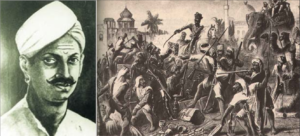
In early 1857, the British introduced the Pattern 1853 Enfield Rifle. To load the rifle, soldiers had to bite off the ends of paper cartridges, which were rumored to be lubricated with grease made from beef tallow (offensive to Hindus) and lard (offensive to Muslims). On March 29, 1857, at Barrackpore, a sepoy named Mangal Pandey attacked British officers, signaling the onset of armed resistance.
2. Main Centers of Resistance and Key Leaders
By mid-May 1857, sepoys in Meerut mutinied, marched to Delhi, and declared the aging Mughal Emperor Bahadur Shah Zafar as the Shahenshah-e-Hindustan (Emperor of India), providing a symbolic figurehead for the rebellion.
| Center of Rebellion | Key Indian Leader(s) | Key British Commander | Outcome |
| Delhi | Bahadur Shah Zafar & General Bakht Khan | John Nicholson, Archdale Wilson | City recaptured in Sept 1857; Emperor exiled to Rangoon. |
| Kanpur | Nana Saheb, Tatya Tope, Azimullah Khan | Colin Campbell, Henry Havelock | Siege of Kanpur; British forces recaptured the city. |
| Lucknow (Awadh) | Begum Hazrat Mahal & Ahmadullah Shah | Henry Lawrence, Colin Campbell | Prolonged Siege of Lucknow; British recaptured in March 1858. |
| Jhansi & Gwalior | Rani Lakshmibai & Tatya Tope | Hugh Rose | Rani killed in battle at Gwalior (June 1858). |
| Bihar (Jagdispur) | Kunwar Singh & Amar Singh | Vincent Eyre | Kunwar Singh led successful guerrilla raids until his death. |
3. Key Phases of the Conflict
                      TIMELINE OF THE 1857 UPRISING
  +-------------------------------------------------------------------+
  | MAY 10, 1857: Outbreak at Meerut; sepoys march to Delhi.          |
  +-------------------------------------------------------------------+
                                    |
                                    v
  +-------------------------------------------------------------------+
  | JUNE-AUGUST 1857: Rapid spread across Awadh, Rohilkhand & Central |
  | India; sieges established at Lucknow, Kanpur, and Delhi.          |
  +-------------------------------------------------------------------+
                                    |
                                    v
  +-------------------------------------------------------------------+
  | SEPTEMBER 1857: Fall of Delhi to British counter-offensive.       |
  +-------------------------------------------------------------------+
                                    |
                                    v
  +-------------------------------------------------------------------+
  | JUNE 1858: Death of Rani Lakshmibai; organized resistance fades. |
  +-------------------------------------------------------------------+
Despite fierce courage and widespread local participation, the rebellion lacked centralized command, unified national strategy, and modern communication infrastructure compared to the British forces, which utilized telegraph networks and railway transport.
4. Aftermath and Structural Transformations
The suppression of the revolt was accompanied by brutal reprisals on both sides, leading to deep structural changes in how the British governed India:
1. Abolition of East India Company Rule
The British Parliament passed the Government of India Act 1858, formally terminating the rule of the East India Company and transferring sovereignty directly to the British Crown under Queen Victoria.
2. The Queen’s Proclamation (1858)
Read by Viceroy Lord Canning at Allahabad, the proclamation promised:
-
An end to territorial annexation policies like the Doctrine of Lapse.
-
Non-interference in local religious traditions and social customs.
-
Equal treatment of Indian subjects under British legal frameworks.
3. Restructuring of the Indian Army
The British reorganized the military to prevent future mutinies:
-
Increased the ratio of European soldiers to Indian sepoys.
-
Separated regiments along regional and caste lines to limit inter-unit cohesion.
-
Introduced the concept of “Martial Races”, preferentially recruiting from regions that had remained loyal during the revolt (e.g., Punjab, Nepal).
5. Historical Significance
The Indian Rebellion of 1857 brought an official end to both the Mughal Empire and Company Rule, inaugurating the era of the British Raj (1858–1947). While the rebellion failed to achieve its immediate goal of expelling the British, it served as an enduring symbol for future generations of the Indian National Movement, establishing anti-colonial resistance on a continental scale.
Category: History of India