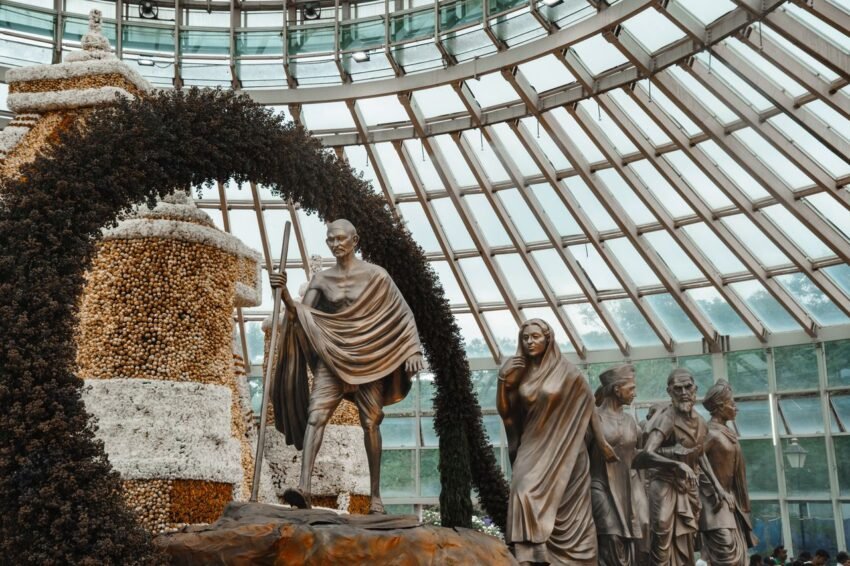
Launched in August 1920 under the leadership of Mahatma Gandhi, the Non-Cooperation Movement was the first nation-wide mass civil-resistance campaign in India’s freedom struggle. It marked a radical departure from the constitutional petitions of the Moderates and the localized boycotts of the early Extremists, transforming the anti-colonial resistance into a massive popular movement that involved peasants, workers, students, women, and the urban middle class.
By uniting the Indian National Congress (INC) with the pan-Islamic Khilafat Movement, Gandhi presented a unified Hindu-Muslim challenge to British rule. The movement aimed to paralyze colonial administration by systematically withholding cooperation from the state, promising Swaraj (self-rule) within a year.
1. Origins and Catalysts: Why Non-Cooperation?
The Non-Cooperation Movement was born out of deep post-World War I disillusionment with British colonial governance. Three primary grievances—often referred to as the “Three Wrongs”—drove the Indian public toward mass resistance:
                    THE THREE CATALYSTS OF 1919–1920
  +-------------------------------------------------------------------+
  | 1. THE ROWLATT ACT & JALLIANWALA BAGH MASSACRE                    |
  | Brutal suppression in Punjab and the failure of the Hunter        |
  | Commission to punish General Dyer shattered faith in British justice.|
  +-------------------------------------------------------------------+
                                    |
                                    v
  +-------------------------------------------------------------------+
  | 2. THE KHILAFAT QUESTION                                          |
  | Discontent among Indian Muslims over the dismemberment of the    |
  | Ottoman Empire and the threat to the Caliphate after World War I. |
  +-------------------------------------------------------------------+
                                    |
                                    v
  +-------------------------------------------------------------------+
  | 3. ECONOMIC DISCONTENT & UNMET POLITICAL PROMISES                 |
  | Wartime inflation, high taxation, and the disappointing reforms    |
  | of the Government of India Act 1919 (Montagu-Chelmsford).         |
  +-------------------------------------------------------------------+
The Khilafat Alliance
Led by the Ali brothers (Maulana Muhammad Ali and Maulana Shaukat Ali), Maulana Abul Kalam Azad, and Hasrat Mohani, the Khilafat Committee sought to safeguard the authority of the Ottoman Caliph. Recognizing a rare opportunity to bridge religious divides, Gandhi convinced the Congress at its special Calcutta session (September 1920) and regular Nagpur session (December 1920) to adopt non-cooperation until the Punjab and Khilafat grievances were redressed and Swaraj was established.
2. Program and Strategy: Constructive and Boycott Dimensions
The movement operated on two distinct pillars: Boycott (withdrawing from colonial institutions) and Constructive Work (building indigenous self-reliance).
                 DUAL STRATEGY OF NON-COOPERATION
  ===================================================================
                       MASS CIVIL RESISTANCE
  ===================================================================
                                 |
           +---------------------+---------------------+
           |                                           |
           v                                           v
    [ NEGATIVE / BOYCOTT ]                     [ POSITIVE / CONSTRUCTIVE ]
  • Surrender of titles and honors.          • Promotion of *Charkha* & *Khadi*.
  • Boycott of government schools,           • Setting up National Schools
    colleges, courts, and councils.            (e.g., Jamia Millia, Kashi Vidyapith).
  • Boycott of foreign cloth and goods.       • Establishment of *Panchayats*.
  • Picketing of liquor shops.               • Anti-untouchability & Hindu-Muslim unity.
Key Phases of Implementation
-
Educational and Legal Boycott: Thousands of students left government-controlled schools and universities. Renowned lawyers like Motilal Nehru, C.R. Das, Saifuddin Kitchlew, Vallabhbhai Patel, and Rajendra Prasad surrendered lucrative legal practices to join the struggle full-time.
-
Foreign Cloth Boycott & Economic Impact: Bonfires of imported textiles blazed across major cities. Imports of foreign cloth plummeted by over 50% between 1920 and 1922, giving a major boost to Indian handloom weavers and mill owners.
-
Symbolic Resistance: When the Prince of Wales visited India in November 1921, he was met with empty streets, closed shops, and massive hartals (strikes) across the country.
3. Mass Participation Across Regions and Classes
The Non-Cooperation Movement extended far beyond major urban centers, sparking regional socio-economic struggles across the subcontinent:
| Region | Regional Manifestation & Key Leadership |
| Punjab | Akali Movement: A non-violent campaign to liberate historic Sikh Gurdwaras from corrupt, British-backed mahants (custodians). |
| Awadh (UP) | Peasant Revolt (Eka Movement): Led by Madari Pasi, peasants refused to pay illegal cesses and high land rents imposed by taluqdars. |
| Andhra Pradesh | Rampa Rebellion & Forest Agitation: Tribal populations led by Alluri Sitarama Raju resisted restrictive colonial forest laws in the Agency tracts. |
| Assam | Tea Garden Strikes: Labor strikes on tea plantations and railway worker strikes led by J.M. Sengupta (Midnapore strikes). |
| Malabar (Kerala) | Moplah Rebellion (1921): Muslim tenants revolted against Hindu landlords and British officials; unfortunately took a communal turn in its later stages. |
4. The Chauri Chaura Incident and Abrupt Withdrawal
By early 1922, the movement was reaching a fever pitch. At the Bardoli session in February 1922, Gandhi announced plans to launch mass non-payment of taxes (no-tax campaign) in Bardoli, Gujarat, signaling the next stage of full civil disobedience.
However, on February 5, 1922, a peaceful procession at Chauri Chaura (in Gorakhpur district, United Provinces) was provoked by local police. The angry crowd clashed with police, forcing officers to retreat inside the police station. The crowd set the station on fire, resulting in the deaths of 22 policemen.
                  THE CHAURI CHAURA DECISION
  +-------------------------------------------------------------------+
  | FEBRUARY 5, 1922: CHAURI CHAURA INCIDENT                          |
  | Violence erupts; 22 policemen killed by a mob in United Provinces.|
  +-------------------------------------------------------------------+
                                    |
                                    v
  +-------------------------------------------------------------------+
  | GANDHI'S MORAL STANCE                                             |
  | Believing the country was not yet sufficiently trained in true    |
  | non-violence (*Ahimsa*), Gandhi unilaterally calls off movement.  |
  +-------------------------------------------------------------------+
                                    |
                                    v
  +-------------------------------------------------------------------+
  | MARCH 1922: ARREST OF GANDHI                                      |
  | Gandhi is arrested and sentenced to six years' imprisonment       |
  | for sedition (though released early in 1924 on medical grounds).  |
  +-------------------------------------------------------------------+
Reactions to the Withdrawal
The sudden withdrawal shocked the national leadership. Young revolutionaries like Bhagat Singh and Subhas Chandra Bose felt deeply disappointed, while senior leaders like Motilal Nehru, Jawaharlal Nehru, and C.R. Das questioned ending a national movement over an isolated incident.
5. Historical Significance and Impact
Despite its abrupt end, the Non-Cooperation Movement reshaped the Indian freedom struggle:
-
Democratization of Nationalism: Nationalism was no longer confined to urban elites or constitutional lawyers. It became a genuine mass movement reaching deep into rural villages.
-
Loss of Fear: The movement dismantled the aura of British invincibility. Millions of ordinary citizens lost their fear of colonial prisons, police batons, and confiscation of property.
-
Organizational Re-structuring: Under Gandhi, the Congress was transformed into a mass political party with hierarchical committees down to the village level, charging a token annual membership fee of 4 annas.
-
Economic Self-Reliance: The movement established the Charkha (spinning wheel) and Khadi as national symbols of self-reliance (Swadeshi) and economic independence.
6. Conclusion
The Non-Cooperation Movement proved that British rule in India depended fundamentally on the passive acquiescence of the governed. By demonstrating the power of organized, non-violent mass action, Gandhi laid the structural and psychological foundation for the next major phase of resistance: the Civil Disobedience Movement of 1930.
Category: History of India