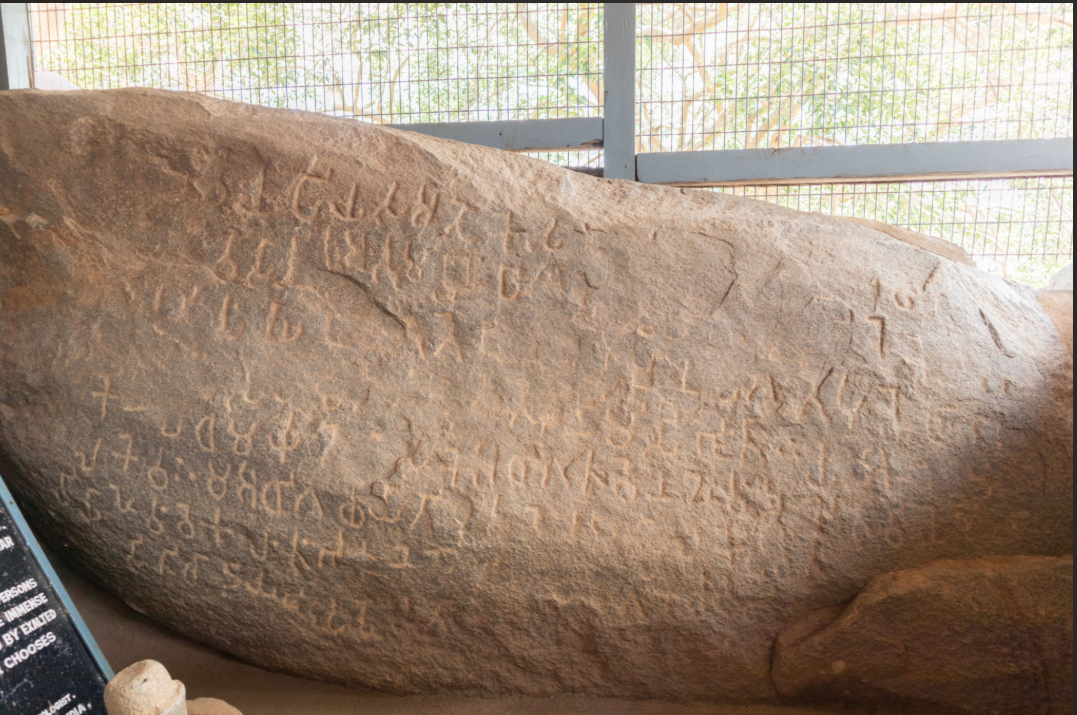
The Third Mauryan Emperor, Ashoka (reigned c. 268–232 BCE), occupies a unique place in world history. Known in his early rule as Chandashoka (“Ashoka the Fierce”) due to his ruthless expansionism and ruthless suppression of rivals, he underwent one of the most remarkable personal and political transformations ever recorded.
This turning point came during his conquest of Kalinga (modern-day Odisha), an event that altered not only the course of his reign but also the religious and ethical landscape of ancient Asia.
1. The Kalinga War (261 BCE): The Catalyst for Change
Eight years after his coronation, Ashoka launched a full-scale military campaign against Kalinga, a strategic maritime kingdom on the eastern coast that controlled vital land and sea trade routes to South India and Southeast Asia.
While the invasion was a military success, the human cost was catastrophic. According to Major Rock Edict XIII, the conflict resulted in:
-
Over 100,000 deaths on the battlefield.
-
More than 150,000 people displaced or taken as prisoners of war.
-
Countless deaths caused by famine, disease, and social collapse in the aftermath.
Surveying the bloodshed along the Daya River near Dhauli, Ashoka was overcome with remorse (Anusochana). The immense human suffering led him to renounce military conquest (Digvijaya) entirely in favor of moral conquest (Dharmavijaya). Shortly after, under the influence of the Buddhist monk Upagupta, Ashoka embraced Buddhism.
2. The Concept of Dhamma: A Universal Moral Code
Ashoka’s policy of Dhamma (the Prakrit form of the Sanskrit Dharma) was not a rigid religious dogma or a mandatory imposition of Buddhism on his subjects. Instead, it was a broad, ethical civic code designed to foster harmony within a multi-religious, multi-ethnic empire.
                   THE PILLARS OF ASHOKA'S DHAMMA
  +---------------------------------------------------------------+
  |  Ahimsa        | Absolute non-violence towards humans & animals|
  |  Samyama       | Tolerance & respect for all religious sects   |
  |  Sushrusha     | Obedience to parents, elders, & teachers      |
  |  Maddava       | Gentleness, truthfulness, & kindness to all   |
  |  Danani        | Generosity to Brahmins, ascetics, & the poor  |
  +---------------------------------------------------------------+
Key Elements of Dhamma Policy:
-
Religious Tolerance: Major Rock Edict XII urges respect for all sects, warning that praising one’s own faith while disparaging another ultimately harms one’s own tradition.
-
Ahimsa and Animal Welfare: Ashoka banned royal hunting expeditions, reduced animal sacrifices in the capital, and established veterinary hospitals across the empire.
-
Public Welfare Infrastructure: He ordered the digging of wells along major highways, planted shade trees, built rest houses (Serais), and promoted the cultivation of medicinal herbs for both humans and animals.
3. The Edicts of Ashoka: Engineering and Literacy
To communicate directly with his subjects, Ashoka carved royal decrees onto massive cliff faces and polished sandstone monoliths across modern-day India, Pakistan, Nepal, and Afghanistan. deciphered in 1837 by British antiquarian James Prinsep, these inscriptions provide invaluable firsthand documentation of Mauryan governance.
| Edict Category | Distribution & Scale | Primary Message / Content |
| Major Rock Edicts | 14 edicts at 8 border sites (e.g., Girnar, Dhauli). | Core principles of Dhamma, renunciation of war, animal protection. |
| Minor Rock Edicts | Scattered throughout interior regions. | Personal declarations of Ashoka’s Buddhist faith and early decrees. |
| Pillar Edicts | Monolithic polished sandstone pillars. | Imperial administrative guidelines, social morality, civic welfare. |
                SCRIPTS OF THE ASHOKAN EDICTS
  +---------------------------------------------------------------+
  |  Brahmi      | Used across core Indian subcontinent sites     |
  |  Kharosthi   | Used in northwestern frontier (Gandhara)       |
  |  Greek/Aramaic| Used in far western outposts (Kandahar)        |
  +---------------------------------------------------------------+
The inscriptions were deliberately written in regional vernacular dialects (predominantly Prakrit) rather than elite Sanskrit, ensuring the messages remained accessible to the general public.
4. Institutionalizing Governance: Dhamma Mahamattas
To ensure his moral decrees were implemented effectively, Ashoka created a dedicated class of high-ranking administrative officers known as Dhamma Mahamattas.
-
Duties: These officers traveled throughout the empire to monitor official conduct, relieve prisoners suffering harsh punishment, distribute royal charity, and arbitrate disputes among different religious communities.
-
Foreign Missions: Ashoka dispatched imperial ambassadors of peace to Hellenistic kingdoms—including Antiochus II of Syria, Ptolemy II of Egypt, and Magas of Cyrene—as well as Sri Lanka and Southeast Asia (Suvarnabhumi), transforming Buddhism into an international movement.
5. Architectural Legacy and National Identity
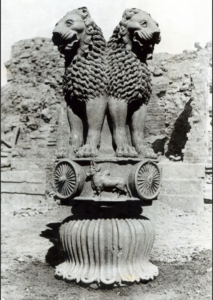
Ashoka’s stone pillars—carved from single blocks of Chunar sandstone and polished to a mirror-like finish—represented a peak in ancient Indian stone carving.
The Lion Capital of Sarnath, erected to mark the site of the Buddha’s first sermon, features four back-to-back Asiatic lions standing over a wheel with 24 spokes (Dharmachakra). Adopted in 1950 as the National Emblem of India, with the Ashoka Chakra positioned at the center of India’s national flag, it stands as a lasting symbol of his legacy of peace, unity, and ethical governance.
Category: History of India