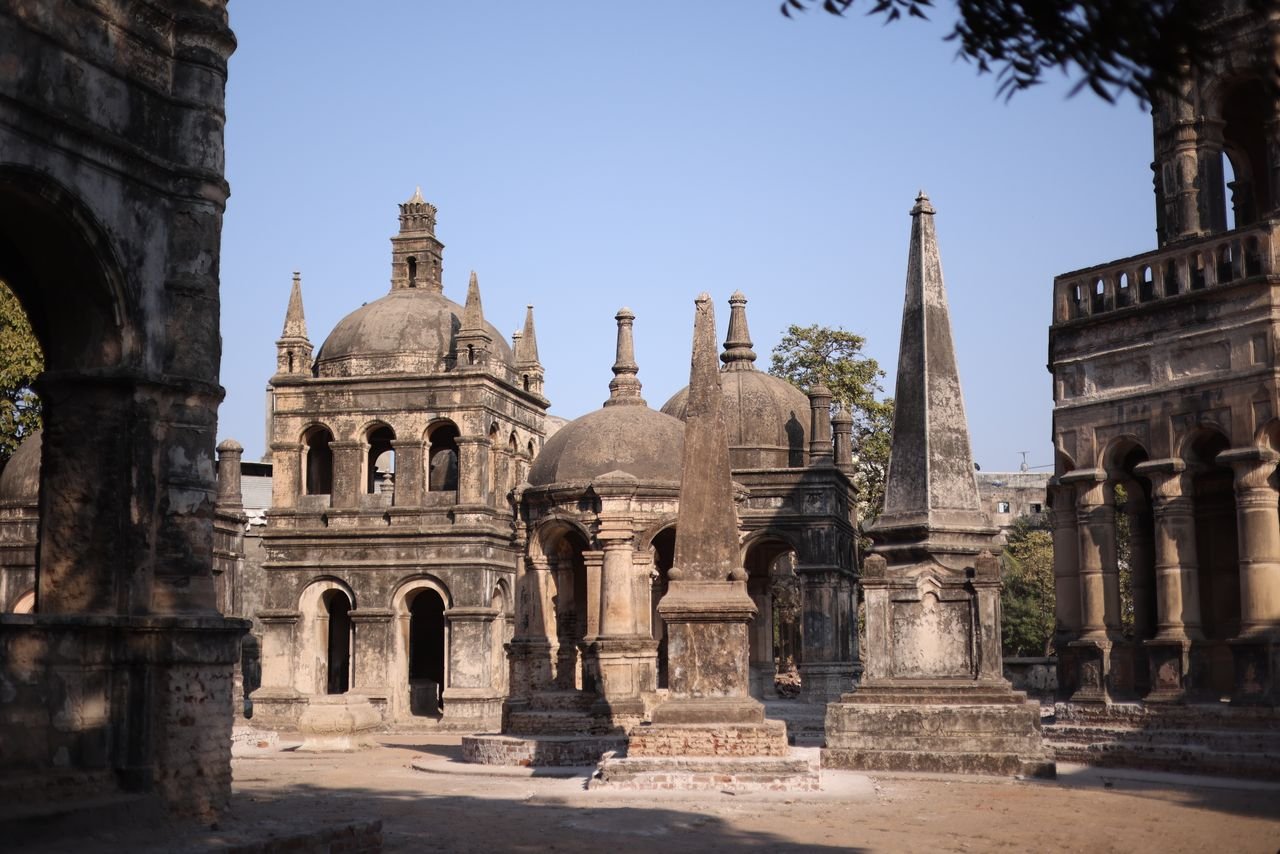
Spanning roughly the 4th to 6th centuries CE, the Gupta Empire (c. 319–543 CE) ruled over a vast swath of northern and central India. Founded by Chandragupta I and expanded through the military and diplomatic genius of Samudragupta and Chandragupta II (Vikramaditya), this era brought political stability, economic prosperity, and unprecedented cultural flourish.
Historians widely refer to the Gupta era as the Golden Age of India. Unburdened by major foreign invasions for over two centuries, intellectual life flourished across mathematics, astronomy, medicine, literature, and temple architecture.
1. Mathematics and Astronomy: Revolutionizing Exact Sciences
Gupta-era scholars transformed ancient science by replacing guesswork with mathematical proof and astronomical calculation.
                      GUPTA SCIENTIFIC BREAKTHROUGHS
  +------------------------------------------------------------------+
  |  Zero & Place Value  | Invention of the decimal place-value system|
  |                      | using 'zero' as a functional digit.       |
  |------------------------------------------------------------------|
  |  Earth's Rotation    | Proved Earth rotates on its axis & causes |
  |                      | day and night cycles.                     |
  |------------------------------------------------------------------|
  |  Eclipses Defined    | Disproved myths; explained solar/lunar    |
  |                      | eclipses via shadow projections.          |
  +------------------------------------------------------------------+
Aryabhata (476–550 CE)
Operating from Pataliputra, the polymath Aryabhata authored the seminal treatise Aryabhatiya at the age of just 23.
-
Mathematics: He calculated the value of Pi ($\pi$) to four decimal places ($3.1416$), introduced early trigonometric sine (jya) functions, and formulated the decimal place-value system that included zero—a discovery that traveled west through Arab mathematicians to transform global science.
-
Astronomy: Aryabhata asserted that the Earth is spherical and rotates on its axis daily. He calculated the solar year to $365.2586$ days and accurately explained that lunar and solar eclipses are caused by Earth and Moon shadows rather than mythic demons.
Varahamihira and Brahmagupta
-
Varahamihira: Wrote the encyclopedic Brihat Samhita, covering astronomy, meteorology, geology, and hydrology.
-
Brahmagupta: Formulated the mathematical rules for computing with zero (including negative numbers) and established foundational algebraic concepts in his Brahmasphutasiddhanta.
2. Classical Literature and the Sanskrit Renaissance
The Gupta court actively patronized Sanskrit literature, elevating the language to its classical peak. Sanskrit shifted from being primarily a liturgical dialect for rituals to a vibrant medium for drama, court poetry, and legal literature.
Kalidasa: The Master Playwright
Celebrated as India’s Shakespeare, Kalidasa served as the premier jewel of Chandragupta II’s court (Navaratnas):
-
Abhijnanashakuntalam: A romantic Sanskrit drama telling the story of King Dushyanta and Shakuntala, universally acclaimed for its poetic elegance.
-
Meghaduta (The Cloud Messenger): A classic poem featuring a longing yaksha sending love messages across India via a passing raincloud.
-
Raghuvamsham & Kumarasambhavam: Masterpieces of epic poetry (Mahakavya).
The period also saw the compiling and finalizing of major epic traditions, including the Mahabharata and Ramayana, along with major Puranas and legal texts like the Manusmriti.
3. Metallurgy, Medicine, and Physical Sciences
Gupta craftsmen mastered high-level metallurgy and medical science:
| Domain | Breakthrough / Artifact | Significance |
| Metallurgy | Iron Pillar of Delhi | Erected by Chandragupta II; stands 23 feet high and has remained completely rust-free despite 1,600 years of outdoor exposure. |
| Sculpture | Sultanganj Buddha | A 7.5-foot copper statue weighing over half a ton, demonstrating advanced copper-casting techniques. |
| Medicine | Sushruta Samhita & Charaka Samhita | Codified internal medicine, pharmacology, plastic surgery (rhinoplasty), and bone setting. |
4. Visual Arts, Rock-Cut Caves, and Architecture
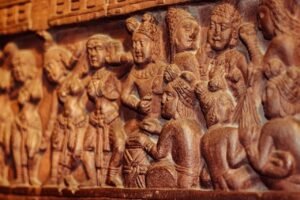
Gupta art moved away from foreign influences like the Gandhara Greek style, developing an idyllic, purely classical Indian aesthetic defined by balance, harmony, and emotional subtlety.
The Frescoes of Ajanta
In the rock-cut caves of Ajanta (in modern Maharashtra), Gupta artists created world-renowned tempera wall paintings. These murals depict the Jataka tales (previous lives of the Buddha) using vibrant natural pigments, featuring delicate facial expressions, rich textiles, and fluid movements.
                  EVOLUTION OF TEMPLE ARCHITECTURE
  +---------------------------------------------------------------+
  |  Early Flat-Roofed Temples  | Simple square cella (Garbhagriha)|
  |                             | with a small columned porch.    |
  |---------------------------------------------------------------|
  |  Emergence of the Shikhara  | Curved, rising roof towers      |
  |                             | (e.g., Dashavatara Temple).     |
  +---------------------------------------------------------------+
Birth of Hindu Temple Architecture
The Gupta period laid the foundational structural design for classical Hindu temples:
-
The Garbhagriha (innermost sanctum housing the primary deity) emerged during this era.
-
The Dashavatara Temple at Deogarh introduced the early rising tower (Shikhara), laying the groundwork for later Nagara and Dravidian architectural styles.
5. Enduring Legacy of the Gupta Golden Age
The decline of the empire in the 6th century—brought on by internal succession disputes and recurring invasions by the Hunas (Central Asian Huns)—did not erase its cultural legacy. The scientific insights, literary works, and artistic styles developed during the Gupta Empire spread across South and Southeast Asia, defining classical Indian civilization for generations to come.
Category: History of India