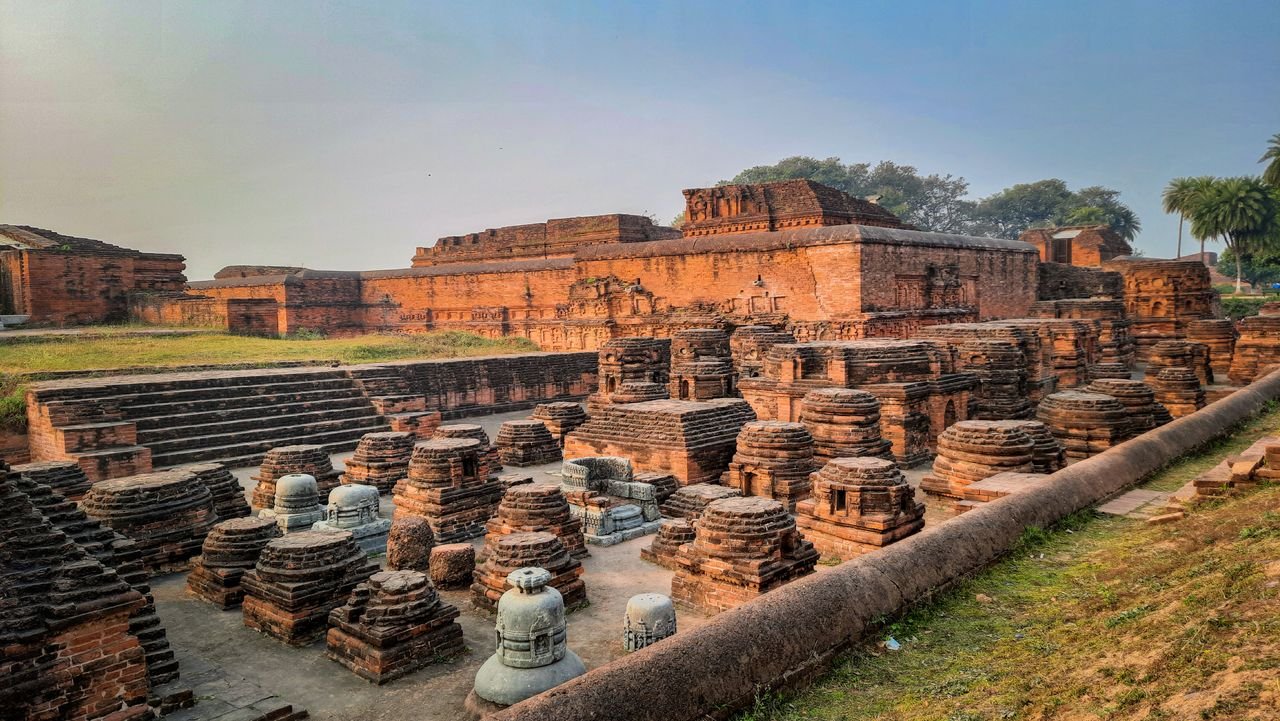
Long before Europe saw the founding of Bologna or Oxford, the Indian subcontinent established the world’s earliest residential university systems. Known collectively as Mahaviharas (great centers of learning), these institutions served as international hubs for higher education, drawing thousands of scholars from China, Korea, Japan, Tibet, Central Asia, and Sri Lanka.
Institutions like Takshashila, Nalanda, and Vikramashila operated not merely as monastic training grounds, but as comprehensive multidisciplinary centers spanning theology, medicine, mathematics, astronomy, linguistics, and statecraft.
1. Takshashila (Taxila): The Cradle of Classical Statecraft and Medicine
Located along the strategic trade routes of Gandhara (near modern-day Islamabad, Pakistan), Takshashila flourished from roughly the 8th century BCE until its destruction by the White Huns (Ephthalites) in the 5th century CE.
                    TAKSHASHILA: HIGHER EDUCATION
  +---------------------------------------------------------------+
  |  Specialization | Advanced professional fields: Medicine,     |
  |                 | Military Tactics, Law, & Political Economy.|
  |---------------------------------------------------------------|
  |  Pedagogy      | One-on-one mentorship under individual masters|
  |                 | rather than a single central senate.        |
  |---------------------------------------------------------------|
  |  Admission     | Minimum entry age of 16; strictly meritocratic|
  |                 | performance-based evaluation.               |
  +---------------------------------------------------------------+
Unlike later institutions, Takshashila operated as an umbrella federation of autonomous faculties led by renowned individual masters (Acharyas).
Notable Alumni and Faculty:
-
Chanakya (Kautilya): Authored the Arthashastra while teaching political science at Takshashila.
-
Charaka: The legendary physician who compiled the foundational Ayurvedic medical text, the Charaka Samhita.
-
Jivaka: The personal physician of King Bimbisara and Gautama Buddha, who studied surgical methods and medicine at Takshashila for seven years.
-
Panini: The ancient linguist who standardized Sanskrit grammar in his treatise, the Astadhyayi.
2. Nalanda: The Pinnacle of Residential Higher Education
Founded in the 5th century CE under the patronage of the Gupta Emperor Kumaragupta I, Nalanda (located in modern Bihar) grew into the world’s most famous residential university. At its peak, it housed over 10,000 students and 2,000 faculty members.
Strict Admissions and Pedagogy
Admissions were strictly merit-based. Applicants were tested at the main entrance gates by guardians known as Dvara-Panditas (gate-keeper scholars). According to the Chinese traveler Xuanzang, only two or three out of ten applicants passed the grueling oral entrance exams.
The Great Library: Dharmaganja
The intellectual heart of Nalanda was its massive library complex, Dharmaganja (“Treasury of Truth”), which spanned three multi-story buildings:
-
Ratnasagara (Ocean of Jewels)
-
Ratnodadhi (Sea of Jewels)
-
Ratnaranjaka (Jewel-Adorned)
                     NALANDA CURRICULUM FRAMEWORK
  +---------------------------------------------------------------+
  |  Mahayana & Theravada Buddhist Philosophy                     |
  |  Vedic Literature, Samkhya, & Nyaya Logic                     |
  |  Medicine (Ayurveda), Anatomy, & Botany                       |
  |  Astronomy, Mathematics, & Metallurgy                         |
  |  Sanskrit Grammar, Linguistics, & Poetics                     |
  +---------------------------------------------------------------+
Nalanda was funded through royal grants and the tax revenues of over 100 surrounding villages, which provided food, clothing, and medicine to all residents free of charge.
3. Vikramashila: The Center for Tantric Studies and Logic
Founded by the Pala Emperor Dharmapala in the late 8th century CE (near modern Bhagalpur, Bihar), Vikramashila was established to maintain high scholarly standards as Nalanda grew larger.
                  VIKRAMASHILA ADMISSION SYSTEM
                       (The Six Gateways)
                               |
    +--------------------------+--------------------------+
    |                          |                          |
    v                          v                          v
East Gate Scholar          North Gate Scholar         South Gate Scholar
 (Grammar/Logic)          (Logic/Epistemology)      (Philosophy/Metaphysics)
-
Specialization: Vikramashila became globally famous for its focus on Vajrayana (Tantric) Buddhism, logic (Hetuvidya), and metaphysics.
-
Governance: Administered by a central council of six gate-keeper scholars (Dvara-Panditas) who oversaw academic standards and entry examinations.
-
Global Influence: Scholars from Vikramashila played a central role in spreading Tantric Buddhism across the Himalayas. The most famous rector, Atisa Dipankara Srijnana, traveled to Tibet in the 11th century to reorganize Tibetan Buddhist traditions.
4. Institutional Comparison
| Feature | Takshashila | Nalanda | Vikramashila |
| Peak Era | 6th century BCE – 5th century CE | 5th century CE – 12th century CE | 8th century CE – 12th century CE |
| Primary Location | Gandhara (Modern Pakistan) | Bihar, India | Bihar, India |
| Organizational Model | Autonomous master-led guilds | Centralized residential university | State-monitored academic senate |
| Key Specialities | Statecraft, Medicine, Military Arts | Logic, Metaphysics, General Sciences | Tantra, Epistemology, Logic |
5. The Tragic Destruction and Legacy
The glorious era of ancient Indian universities came to a sudden and tragic end in the late 12th and early 13th centuries. The Turkic commander Bakhtiyar Khilji raided and destroyed Nalanda and Vikramashila around 1193–1200 CE during the expansion of the Delhi Sultanate. Historical accounts record that Nalanda’s massive library burned for months, destroying thousands of irreplaceable manuscripts on ancient science, medicine, and philosophy.
Despite their physical destruction, these Mahaviharas established early models for structured higher education: residential campuses, rigorous admissions, peer-reviewed debate, public funding models, and comprehensive multidisciplinary study.
Category: History of India