Reigning from 1556 to 1605 CE, Jalal-ud-din Muhammad Akbar, the third Mughal emperor, transformed a fragile military conquest into a consolidated, highly organized empire. Inheriting a unstable realm at age 13 following the sudden death of Humayun, Akbar recognized that military force alone could not hold the vast Indian subcontinent.
By combining administrative reforms with socio-religious integration, Akbar established an institutional framework that sustained the Mughal Empire at its peak for well over a century.
1. The Mansabdari System: The Backbone of Governance
Introduced around 1575 CE, the Mansabdari system was a bureaucratic and military hierarchy that bound the nobility directly to the crown, replacing hereditary feudal allegiances with a centralized salary structure.
Dual Rank Structure: Zat and Sawar
Every imperial officer was designated a Mansabdar (holder of a rank/position) and assigned two numeric ranks:
-
Zat: Determined the personal status, precedence, and base salary of the officer within the imperial court hierarchy.
-
Sawar: Specified the exact number of cavalrymen and armored warhorses the officer was required to maintain and bring for military service.
                     THE DUAL MANSABDARI RANK STRUCTURE
  +-------------------------------------------------------------------+
  | MANSA3DAR (Imperial Officer)                                       |
  |-------------------------------------------------------------------|
  |  ZAT RANK (e.g., 5,000)   --> Personal Status & Base Salary      |
  |  SAWAR RANK (e.g., 3,000) --> Required Cavalry Contingent         |
  +-------------------------------------------------------------------+
Administrative Safeguards
-
Non-Hereditary Appointments: Ranks were granted personally by the emperor and lapsed upon the holder’s death. The state claimed the deceased Mansabdar’s assets under the Escheat system (Zabt-i-Mawalkat).
-
Payment Methods: Officers were paid either in direct cash (Naqdi) or through revenue assignments on land called Jagirs (Jagirdars). To prevent local power bases from forming, Jagirs were routinely rotated every 3 to 4 years.
-
Inclusive Nobility: Akbar recruited Turanis, Iranis, Indian Muslims, Rajputs, and Marathas into the Mansabdari corps, creating a multi-ethnic ruling elite dependent entirely on royal favor.
2. Agrarian and Revenue Overhaul: Todar Mal’s Dahsala System
To ensure a predictable financial base for his expansionist state, Akbar commissioned his finance minister, Raja Todar Mal, to conduct a comprehensive overhaul of land revenue collection.
Rolled out in 1580 CE, this initiative was known as the Dahsala System (or Zabt System).
                      TODAR MAL'S DAHSALA REVENUE PIPELINE
  +-------------------------------------------------------------------+
  | Land Surveying: Imperial bamboo measuring rods with iron rings.   |
  +-------------------------------------------------------------------+
                                    |
                                    v
  +-------------------------------------------------------------------+
  | Classification: Land categorized by cultivation frequency         |
  | (Polaj, Parauti, Chachar, Banjar).                               |
  +-------------------------------------------------------------------+
                                    |
                                    v
  +-------------------------------------------------------------------+
  | Revenue Calculation: Tax fixed at 1/3rd of average 10-year yield, |
  | converted into cash based on local market price schedules.        |
  +-------------------------------------------------------------------+
Land Classification Criteria
| Category | Cultivation Schedule | Tax Status |
| Polaj | Annually cultivated for each crop without rest. | Full revenue rates applied annually. |
| Parauti | Left fallow temporarily to recover fertility. | Taxed only when brought under cultivation. |
| Chachar | Left fallow for 3 to 4 years. | Concessional rates applied gradually. |
| Banjar | Uncultivated for 5 or more years. | Minimal symbolic rates to encourage reclamation. |
3. Ideological Evolution: Sulh-i-Kul and the Ibadat Khana
Akbar understood that ruling a predominantly Hindu population required moving away from orthodox religious policies. He systematically repealed discriminatory measures, abolishing the tax on Hindu pilgrims in 1563 CE and the Jizya tax on non-Muslim subjects in 1564 CE.
                     AKBAR'S RELIGIOUS POLICY EVOLUTION
  1564 CE: Abolition of Jizya & Pilgrim Taxes
     |
     v
  1575 CE: Construction of the Ibadat Khana at Fatehpur Sikri
     |
     v
  1579 CE: Issuance of the Infallibility Decree (*Mahzar*)
     |
     v
  1582 CE: Promulgation of Sulh-i-Kul & Din-i-Ilahi
The Ibadat Khana Debates
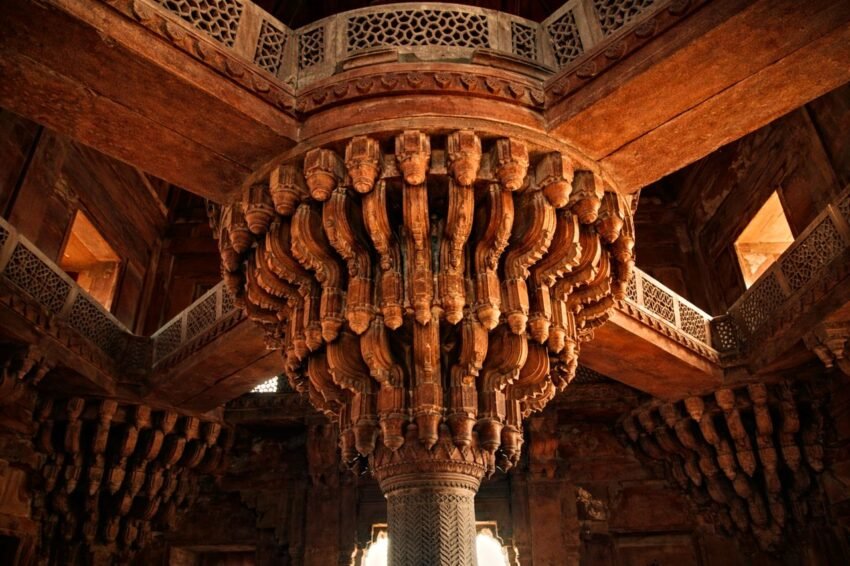
In 1575 CE, Akbar built the Ibadat Khana (House of Worship) at his capital, Fatehpur Sikri.
Initially constructed for debates among Sunni theologians, the fractious arguments disappointed Akbar. He expanded the forum to include Shia scholars, Hindu pundits, Jain monks (Hiravijaya Suri), Zoroastrian priests, and Portuguese Jesuit missionaries (Rodolfo Acquaviva).
Sulh-i-Kul (Universal Peace)
From these interfaith discussions emerged the state doctrine of Sulh-i-Kul—a policy of universal peace, state neutrality in religious affairs, and equal patronage for all subjects regardless of creed.
4. Din-i-Ilahi (Tauhid-i-Ilahi)
In 1582 CE, Akbar introduced Din-i-Ilahi (“Divine Faith” or Tauhid-i-Ilahi). Rather than a formal new religion with scriptures, dogmas, or a priesthood, it functioned as an elite ethical code designed to bond high-ranking court officers directly to the sovereign.
Key Elements of Din-i-Ilahi:
-
Ethical Precepts: Synthesized elements of Islamic Sufism, Hindu Vedantic principles, Jain vegetarianism, and Zoroastrian sun reverence.
-
Core Principles: Members pledged loyalty, property, honor, and life to the emperor, abstained from meat, practiced charity, and greeted fellow initiates with “Allahu Akbar” and “Jalla Jalaluhu”.
-
Limited Scope: Akbar never forced conversion or sought mass adoption. The order remained an exclusive court society with fewer than twenty core adherents, including his trusted general Raja Birbal.
5. Enduring Legacy
Akbar’s administrative innovations redefined statecraft across South Asia. By decoupling state revenue and military appointments from religious affiliation, he forged a unified imperial structure.
The institutional framework he established—combining the military precision of the Mansabdari system, the economic clarity of the Dahsala system, and the inclusive philosophy of Sulh-i-Kul—built the foundation for the golden age of the Mughal Empire.
Category: History of India