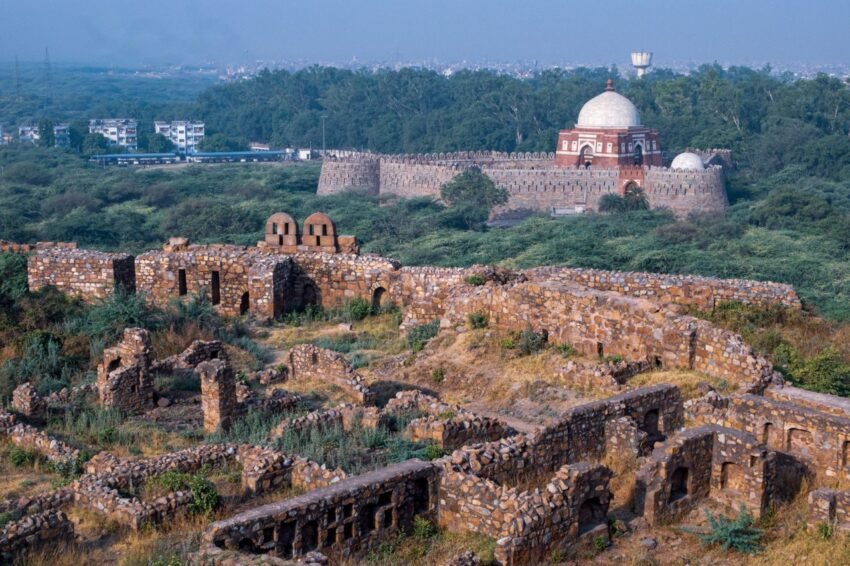
On April 21, 1526, on the dusty plains of Panipat north of Delhi, a pivotal clash altered the trajectory of South Asian history. Zahir-ud-din Muhammad Babur, a Timurid prince who had lost his ancestral stronghold of Fergana in Central Asia and carved out a kingdom in Kabul, faced Ibrahim Lodi, the Sultan of Delhi.
Despite being outnumbered roughly four to one, Babur achieved a decisive victory using field artillery, matchlocks, and coordinated tactical maneuvers. This triumph ended the Lodi Dynasty and marked the founding of the Mughal Empire.
1. Context: Geopolitics and Invitation to Invade
By the early 1520s, the Delhi Sultanate under Ibrahim Lodi was fractured by internal rebellion and noble disaffection.
-
The Invitation: Daulat Khan Lodi (Governor of Punjab) and Alam Khan (Ibrahim’s uncle) invited Babur to invade Delhi and overthrow the unpopular Sultan.
-
Babur’s Ambition: Having launched four minor raids into Northern India between 1519 and 1524, Babur recognized that Delhi’s internal disunity created an ideal opportunity for permanent conquest.
2. Comparative Force Capabilities at Panipat
While Ibrahim Lodi commanded a vast, traditional army dependent on war elephants and frontal cavalry charges, Babur deployed a compact force trained in combined-arms warfare.
| Strategic Dimension | Babur’s Mughal Force | Ibrahim Lodi’s Delhi Sultanate Force |
| Numerical Strength | ~12,000 to 15,000 disciplined troops. | Estimated 40,000 to 100,000 troops + ~1,000 war elephants. |
| Primary Weaponry | Field cannons, matchlocks (matchlockmen), compound bows. | Swords, lances, spears, longbows, war elephants. |
| Key Commanders | Ustad Ali Quli (Artillery), Mustafa Rumi (Matchlocks). | Ibrahim Lodi (Direct command), various regional Afghan commanders. |
| Tactical Approach | Defensive-offensive position utilizing field fortifications. | Traditional frontal mass charge relying on sheer numbers. |
3. Tactical Innovations: The Gunpowder Revolution
Babur introduced a tactical doctrine adapted from Ottoman military practices (Rumi tactics), blending heavy gunpowder power with fast-moving Central Asian horse archery.
Key Tactical Formations
-
The Arba System (Gun Carts): Babur tied together 700 wooden carts (Arba) using braided leather ropes. Between every pair of carts, his engineers erected mantlets (wooden shields, or Tora) behind which matchlockmen (Tufangchis) could safely reload and fire.
-
Field Artillery Deployment: Interspersed along the cart line were heavy field cannons commanded by Ottoman expert Ustad Ali Quli and matchlock lines under Mustafa Rumi.
-
The Tulughma Flanking Maneuver: Babur divided his cavalry into distinct left, right, and center divisions, reserving elite flanking units (Tulughma) on the extreme wings. Their objective was to encircle the enemy from behind once the advance stalled against the cart barricade.
                  BABUR'S BATTLEFIELD DEPLOYMENT AT PANIPAT
  ===================================================================
     [Left Wing Cavalry]    [BARRIER OF CARTS + CANNONS]    [Right Wing Cavalry]
                            (Ustad Ali Quli & Mustafa Rumi)
  ===================================================================
                                      ^
                                      | (Frontal Impact Stalls)
  ===================================================================
                      IBRAHIM LODI'S ADVANCING MASS
                     (Infantry + 1,000 War Elephants)
  ===================================================================
                                      |
         <-- [Tulughma Left]                    [Tulughma Right] -->
             (Encircling Cavalry sweeps around to trap Lodi's Rear)
4. The Course of the Battle
When Ibrahim Lodi’s forces advanced on the morning of April 21, 1526, they encountered Babur’s fortified line anchored by the town of Panipat on the right flank and a man-made ditch with fallen trees on the left.
-
Panic Among the Elephants: As Lodi’s war elephants approached the cart barricade, the loud, unfamiliar roar and smoke of Ustad Ali’s cannons panicked the beasts, causing them to turn back and trample their own infantry.
-
The Trap Closes: With the Sultanate’s frontal assault stalled against the fortified gun line, Babur ordered his Tulughma horse archers to sweep around both flanks. Lodi’s massive army found itself compressed from three sides into a crowded center where numbers offered no advantage.
-
Final Defeat: Within three hours, Ibrahim Lodi was killed on the field alongside roughly 20,000 of his soldiers.
5. Historical Impact and Legacy
Babur’s victory at Panipat established a new military standard across the Indian subcontinent:
-
Rise of Gunpowder Empires: Panipat demonstrated that field artillery and hand-held firearms had rendered traditional war-elephant warfare obsolete.
-
Founding of Mughal Rule: Babur captured Delhi and Agra, laying the territorial foundation for an empire that would unite most of South India and North India under a centralized bureaucracy.
-
Precursor to Khanwa: The victory at Panipat set up Babur’s next decisive encounter at the Battle of Khanwa (1527) against Rana Sanga of Mewar, cementing Mughal control over North India.
Category: History of India