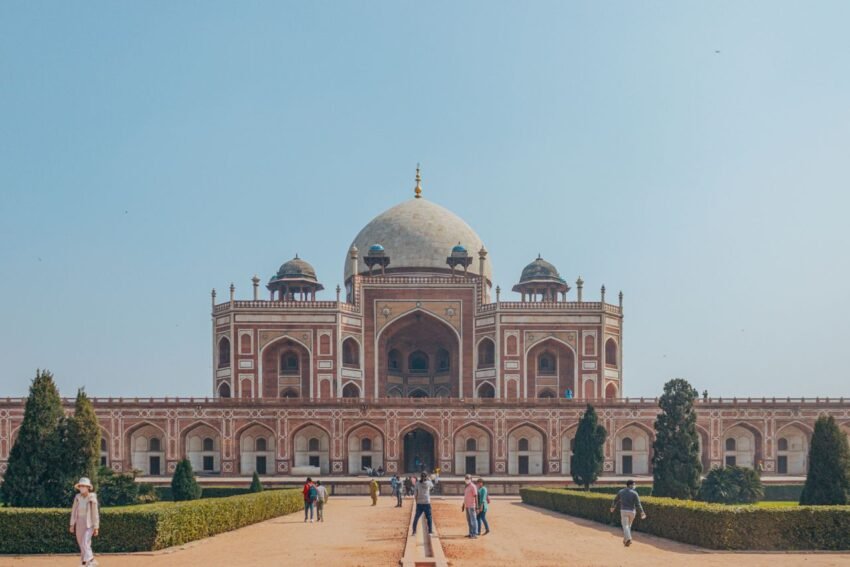
Mughal miniature painting represents one of the most brilliant intersections of Persian artistic traditions, indigenous Indian aesthetics, and European Renaissance influences. Spanning the 16th and 17th centuries, this imperial art form evolved from formal Persian manuscript illumination into a dynamic, highly naturalistic visual archive of imperial power, courtly culture, and environmental study.
The artistic journey across the reigns of Humayun, Akbar, and Jahangir reflects an aesthetic shift: transitioning from stylized storytelling and mass studio collaboration to psychological portraiture and meticulous naturalism.
1. The Persian Foundations under Humayun (1530–1556 CE)
The story of Mughal painting began with Emperor Humayun’s political exile in Safavid Persia. While hosted at the court of Shah Tahmasp in Isfahan, Humayun developed a deep appreciation for Persian miniature traditions characterized by two-dimensional perspective, intricate geometric patterning, and rich lapis lazuli pigments.
                      FOUNDATIONAL PERSIAN INFLUX
  +-------------------------------------------------------------------+
  | HUMAYUN'S EXILE IN SAFAGID PERSIA                                  |
  | Absorbs Safavid artistic techniques and manuscript conventions.  |
  +-------------------------------------------------------------------+
                                    |
                                    v
  +-------------------------------------------------------------------+
  | ROYAL ATELIER FOUNDATION (Kabul, c. 1549 CE)                       |
  | Recruits Persian master painters Mir Sayyid Ali and Abd al-Samad. |
  +-------------------------------------------------------------------+
                                    |
                                    v
  +-------------------------------------------------------------------+
  | MUGHAL SCHOOL BIRTH (Delhi/Agra)                                  |
  | Fusion of Safavid flat precision with native Indian realism.      |
  +-------------------------------------------------------------------+
Upon reclaiming his throne in Delhi in 1555 CE, Humayun brought two legendary Persian master painters—Mir Sayyid Ali and Abd al-Samad—to lead his imperial atelier. These masters established the foundational techniques, brushwork standards, and pigment formulas that would train the first generation of native Indian court artists.
2. Akbar’s Tasvir Khana: Dynamic Narrative and Synthesis (1556–1605 CE)
Under Emperor Akbar, the royal studio (Tasvir Khana) grew into an organized imperial department employing over a hundred artists, including Hindu painters like Daswanth and Basawan. Akbar prioritized narrative action, historical documentation, and thematic variety over classical Persian restraint.
Key Innovations of the Akbari Period
-
Massive Narrative Manuscripts: The atelier produced monumental illustrated epics, beginning with the monumental Hamzanama (Adventures of Amir Hamza, featuring 1,400 large cloth paintings) followed by the Tutinama (Tales of a Parrot), Razmnama (Persian translation of the Mahabharata), and the Akbarnama.
-
Integration of European Elements: Through encounters with Portuguese Jesuit missionaries, Akbari artists adopted European techniques such as atmospheric perspective, shading (pardaz) to give figures three-dimensional mass, and realistic drapery folds.
-
Collaborative Studio Production: Works were rarely painted by a single hand. One artist drew the outline (tarh), another executed the painting (amal), and specialist portraitists refined key faces (chehranami).
3. Jahangir’s Reign: The Zenith of Realism and Naturalism (1605–1627 CE)
Emperor Jahangir shifted the focus of the imperial atelier away from crowded narrative scenes to individual artistic expression, refined portraiture, and nature studies. Possessing an extraordinary connoisseurship, Jahangir claimed he could identify the specific painter of any face or detail in a composite artwork.
Characteristics of the Jahangiri Style
-
Psychological Realism: Portraits abandoned stylized heroic figures in favor of intimate, expressive characterizations capturing age, mood, and status.
-
Mastery of Natural History: Jahangir commissioned detailed scientific illustrations of flora and fauna. His chief court naturalist painter, Ustad Mansur (Nadir-al-Asr), produced iconic depictions of rare animals, birds, and flowers, including the famous studies of the Dodo bird and the Falcon.
-
Allegorical Royal Portraiture: Influenced by European Baroque art, paintings depicted Jahangir surrounded by divine halos, interacting with global monarchs, or standing atop terrestrial globes.
4. Comparative Evolution Across Three Reigns
| Aesthetic Attribute | Humayun Period (1530–1556) | Akbar Period (1556–1605) | Jahangir Period (1605–1627) |
| Primary Focus | Classical Persian text illumination. | Dynamic historical narrative & myth. | Natural history, royal portraiture & allegory. |
| Spatial Perspective | Flat, two-dimensional Safavid style. | Emerging depth via European techniques. | Sophisticated spatial depth & natural shading. |
| Studio Process | Persian masters with small apprenticeships. | Large-scale collaborative assembly lines. | Single-artist master works & individual focus. |
| Key Master Artists | Mir Sayyid Ali, Abd al-Samad. | Daswanth, Basawan, Kesu Das. | Ustad Mansur, Abul Hasan, Bishandas. |
5. Artistic Legacy
The evolution of Mughal miniature painting under Humayun, Akbar, and Jahangir established a visually distinct art form that profoundly influenced regional Indian schools, including Rajput, Pahari, and Deccani painting traditions. By blending Persian geometric precision, Indian color palettes, and European realism, Mughal artists created a visual legacy that captured the imperial identity of South Asia during its early modern golden age.
Category: History of India