
By the 6th century BCE, the socio-political landscape of northern India underwent a monumental shift known as the Second Urbanization. As iron tools (krishna ayas) enabled widespread clearing of the dense forests across the Gangetic plains, agricultural surpluses surged. Small tribal settlements (Janapadas) coalesced into powerful territorial states called Mahajanapadas (“Great Realms”).
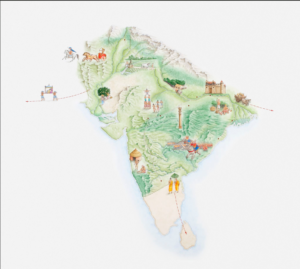
Early Buddhist texts, particularly the Anguttara Nikaya, and Jain texts like the Bhagavati Sutra list sixteen major Mahajanapadas that dominated the subcontinent, stretching from the northwest frontier (modern Afghanistan) down to the Godavari basin in central India.
1. Dual Systems of Governance: Monarchies vs. Republics
The Mahajanapadas were not politically uniform. They were divided into two distinctly different political models: hereditary monarchies (Rajyas) and oligarchic republics (Ganasanghas).
| Governance Aspect | Monarchies (Rajyas) | Republics (Ganasanghas) |
| Key Examples | Magadha, Kosala, Vatsa, Avanti | Vajji (Vrijji), Malla, Shakya, Kamboja |
| Power Structure | Absolute power vested in a hereditary king (Rajan). | Power shared by an assembly (Santhagara) of clan chiefs or heads. |
| Revenue Model | Systematic tax collection (Bali and Bhaga) paid to the royal treasury. | Revenues directly collected by ruling lineages; no central standing tax body. |
| Military | Permanent standing armies maintained by the state. | Citizen-militias led by individual clan leaders during wartime. |
The Vajji Confederacy, centered at Vaishali, stood out as a premier example of a Ganasangha. Governed by a council of 7,707 Rajas (representatives of ruling families), Vajji functioned through debate and voting, providing an early precedent for collective democratic decision-making in ancient Asia.
2. Economic Catalysts: Iron, Currency, and Agriculture
The transformation from nomadic pastoralism to urban statecraft relied on three crucial developments:
-
Iron Technology: The widespread adoption of iron plowshares revolutionized agriculture in the fertile, alluvial soil of the Indo-Gangetic plain. Paddy transplantation techniques dramatically increased crop yields, creating large agricultural surpluses capable of supporting non-farming urban populations.
-
Punch-Marked Coins: The emergence of standardized silver and copper punch-marked coins (Karshapanas) replaced barter trade, facilitating long-distance commerce and enabling monarchs to pay standing armies and bureaucratic administrations.
-
Guilds and Trade Routes: Organized merchant guilds (Srenis) established trade highways like the Uttarapatha (Northern trade route connecting Taxila to Magadha) and Dakshinapatha (Southern trade route), turning fortified capitals into thriving commercial hubs.
3. The Imperial Ascent of Magadha
Out of the sixteen competitive states, four major powers eventually dominated the struggle for supremacy: Magadha, Kosala, Vatsa, and Avanti. Ultimately, Magadha emerged as the unquestioned master of the Gangetic plain due to several geographic, economic, and strategic advantages:
-
Strategic Geography: Magadha’s early capital, Rajagriha (Rajgir), was surrounded by five natural protective hills. Its later capital, Pataliputra, sat at the confluence of the Ganges, Son, and Gandak rivers, serving as a water-fortress (Jaladurga) for military movement and trade control.
-
Natural Resources: Rich iron-ore deposits in nearby Chota Nagpur provided an abundant supply of durable weapons and agricultural tools.
-
War Elephants: Unlike western rivals who relied primarily on cavalry, Magadha was among the first to systematically train and deploy wild war elephants from the dense forests of Bihar and Bengal to break enemy lines.
-
Ambitious Rulers: Dynamic dynasties led the expansion:
-
Bimbisara (Haryanka Dynasty): Secured alliances through strategic marriages (with Kosala, Vaishali, and Madra) and annexed the trade center of Anga.
-
Ajatashatru: Built advanced siege weaponry (the Rathamusala war chariot and Mahashilakantaka catapult) and annexed the Vajji Confederacy after a 16-year campaign.
-
The Nanda Dynasty: Built a massive standing army and consolidated control over northern India, laying the administrative and territorial groundwork for the Maurya Empire.
-
4. Legacy of the 16 Kingdoms
The era of the Mahajanapadas completely altered ancient Indian politics. By replacing tribal affiliations with territorial identity, it established centralized taxation, permanent standing armies, and urban civil administration. Furthermore, the intellectual freedom found in urban capitals like Vaishali, Varanasi, and Rajagriha provided the social foundation for transformative philosophical movements, including early Buddhism and Jainism.
Category: History of India