In the late 19th century, amidst colonial subjugation and ideological challenges from Western materialist philosophy and Christian missionary activity, India witnessed a powerful spiritual and intellectual revitalization known as the Hindu Renaissance. While early reform movements like the Brahmo Samaj focused on social legislation and scriptural reinterpretation, Swami Vivekananda (1863–1902) catalyzed a spiritual awakenings that bridged ancient Vedantic wisdom with modern nationalist consciousness.
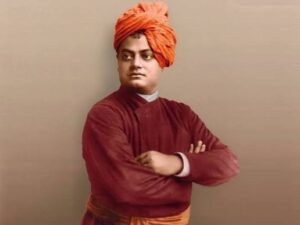
As the chief disciple of the mystic Sri Ramakrishna Paramahamsa, Vivekananda rearticulated classical Advaita Vedanta into a dynamic, practical philosophy (Practical Vedanta). By championing religious tolerance, social service, and self-reliance, he restored national pride and projected Indian spiritual heritage onto the global stage.
1. Early Life and Spiritual Transformation
Born Narendranath Datta into an educated, aristocratic Bengali family in Calcutta, the young Narendra was an intellectually curious youth deeply influenced by Western logic, philosophy, and science.
                  NARENDRANATH'S SPIRITUAL EVOLUTION
  +-------------------------------------------------------------------+
  | WESTERN RATIONALISM & BRAHMO INFLUENCE                            |
  | Young Narendra joins the Brahmo Samaj, seeking rational proof    |
  | of God's existence and rejecting superstitious dogma.            |
  +-------------------------------------------------------------------+
                                    |
                                    v
  +-------------------------------------------------------------------+
  | ENCOUNTER WITH SRI RAMAKRISHNA (1881)                             |
  | Meets the mystic of Dakshineswar and asks: "Have you seen God?"   |
  | Ramakrishna replies: "Yes, I see Him as clearly as I see you."   |
  +-------------------------------------------------------------------+
                                    |
                                    v
  +-------------------------------------------------------------------+
  | MONASTIC TRANSFORMATION & WANDERING MONK (*PARIVRAJAKA*)           |
  | Takes monastic vows, travels across India on foot (1888–1893),     |
  | witnessing both deep spiritual heritage and extreme poverty.      |
  +-------------------------------------------------------------------+
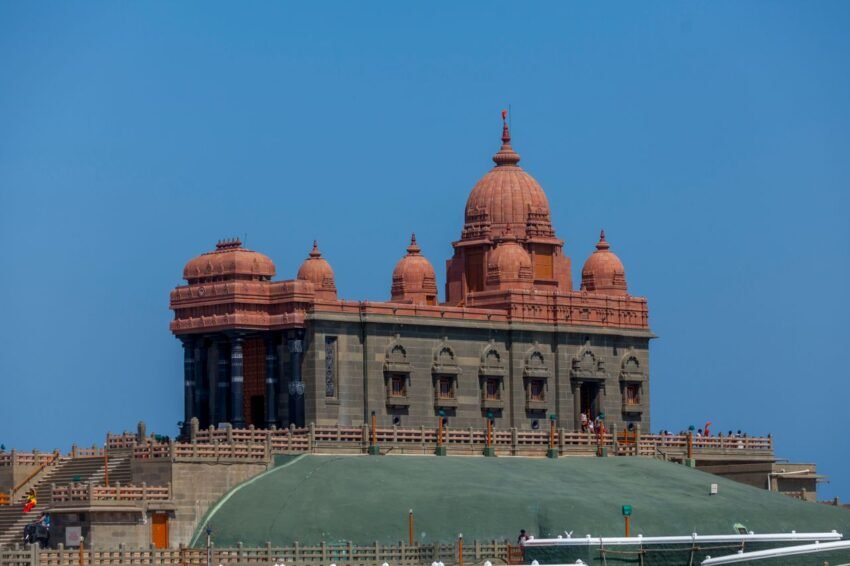
During his travels as a wandering monk (Parivrajaka), Narendra experienced the harsh realities of colonial poverty, illiteracy, and social stagnation. Standing at Kanyakumari (the southernmost tip of India) in December 1892, he meditated on a rock off the coast, realizing his life’s core mission: spiritual rejuvenation and social elevation of the Indian masses must go hand in hand.
2. The 1893 Chicago Speech: Global Recognition
In September 1893, Vivekananda represented Hinduism at the Parliament of the World’s Religions in Chicago. Opening his address with the iconic words, “Sisters and Brothers of America,” he received a standing ovation from an audience of over seven thousand people.
Key Themes of the Chicago Address
-
Universal Acceptance and Tolerance: He proudly proclaimed that Hinduism taught the world both tolerance and universal acceptance, quoting the ancient Sanskrit verse: “As the different streams having their sources in different places all mingle their water in the sea, so, O Lord, the different paths which men take… all lead to Thee.”
-
Rejection of Fanaticism: He delivered a ringing condemnation of sectarianism, bigotry, and fanaticism, warning that they had long filled the earth with violence and hindered human progress.
-
Harmonizing East and West: He argued that while the West excelled in material science and technology, the East offered profound spiritual insights. True human progress required a synthesis of Western material organization and Eastern spiritual depth.
3. Practical Vedanta and Social Service
Vivekananda’s primary philosophical contribution was Practical Vedanta—taking the abstract monistic philosophy of Advaita Vedanta out of secluded caves and monastic hermitages into the active sphere of daily social life.
                      THE CORE TENETS OF PRACTICAL VEDANTA
  ===================================================================
                  ALL HUMANITY IS DIVINE AT ITS CORE
  ===================================================================
                                 |
           +---------------------+---------------------+
           |                     |                     |
           v                     v                     v
    [ DARIDRA NARAYANA ]   [ WORK AS WORSHIP ]   [ SELF-RELIANCE ]
  Service to the poor and  *Karma Yoga*: Serving  Strength, courage, and
  oppressed is direct      humanity is the highest moral vigor as true
  worship of God.          form of spiritual duty. spiritual qualities.
-
Daridra Narayana (God in the Poor): Vivekananda famously asserted: “Where should you go to seek God—are not all the poor, the miserable, the weak, God? Why not worship them first?”
-
Empowerment Through Education: He advocated for mass education that built character, strengthened the mind, and enabled individuals to stand on their own feet.
4. Foundation of the Ramakrishna Math and Mission
To operationalize his vision of combined spiritual pursuit and social humanitarian work, Vivekananda established the Ramakrishna Math and Ramakrishna Mission on May 1, 1897, near Calcutta (headquartered at Belur Math).
                 DUAL MOTTO OF THE RAMAKRISHNA MISSION
  ===================================================================
      "Atmano Mokshartham Jagat Hitaya Cha"
      (For one's own salvation and for the welfare of the world)
  ===================================================================
                                 |
           +---------------------+---------------------+
           |                                           |
           v                                           v
  [ SPIRITUAL CONQUEST ]                     [ HUMANITARIAN SERVICE ]
  Monastic discipline, meditation,           Famine relief, disaster response,
  and scriptural study.                      hospitals, schools, and orphanages.
The Ramakrishna Mission established a new paradigm for Indian monasticism: monks were no longer recluse ascetics detached from society, but active agents of social relief, healthcare, and education.
5. Legacy and Impact on Indian Nationalism
Though Vivekananda explicitly avoided active politics, his writings and speeches served as an intellectual catalyst for the Indian National Movement:
| Aspect | Contribution and Influence |
| Spiritual Nationalism | Inspired national leaders like Bal Gangadhar Tilak, Aurobindo Ghose, and Subhas Chandra Bose, who called Vivekananda the “maker of modern India.” |
| National Self-Respect | Countered colonial claims of Indian cultural inferiority by proving the global relevance of Indian philosophy. |
| Youth Awakening | Emphasized physical fitness, courage, and moral strength, urging youth to have “muscles of iron and nerves of steel.” |
| National Youth Day | His birthday, January 12, is celebrated annually across India as National Youth Day to honor his enduring legacy. |
6. Conclusion
Swami Vivekananda’s life and work transformed the 19th-century Hindu Renaissance from an introspective reform movement into an outward-looking, socially dynamic force. By grounding social action in Vedantic unity and elevating national service to a sacred duty, Vivekananda provided the moral and philosophical bedrock for India’s awakening in the 20th century.
Category: History of India