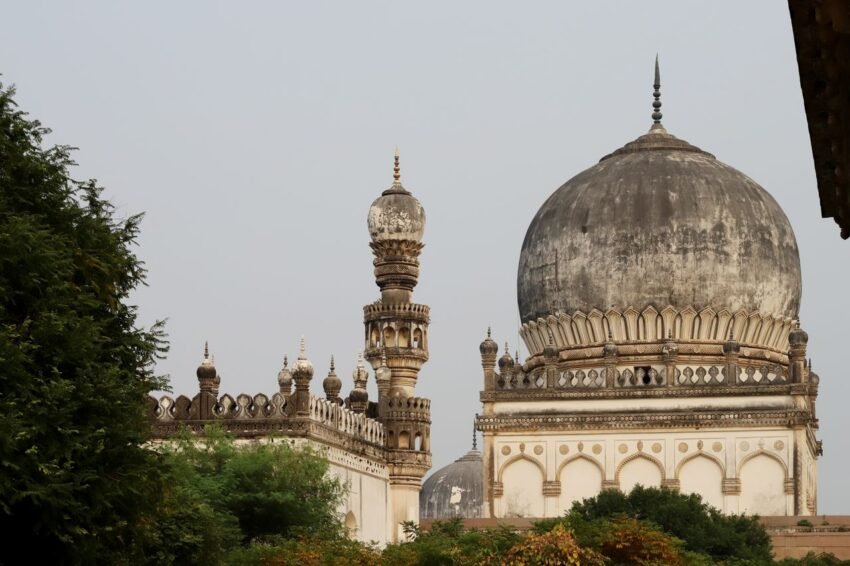
Founded in 1347 CE by Ala-ud-Din Bahman Shah (born Hasan Gangu), the Bahmani Kingdom emerged as the first independent Muslim empire in the Deccan plateau. Revolt against the unstable rule of Muhammad bin Tughlaq of the Delhi Sultanate allowed local nobles to establish a distinct sovereign realm spanning from the Arabian Sea to the Bay of Bengal.
For nearly two centuries, the Bahmani state served as a powerful counterweight to the neighboring Vijayanagara Empire across the Krishna-Tungabhadra doab, driving significant innovations in administrative organization, cross-continental trade, and Deccani architecture.
1. Governance, Factionalism, and Mahmud Gawan’s Reforms
The administration of the Bahmani Kingdom was originally divided into four major provinces (Tarafs): Gulbarga, Daulatabad, Berar, and Bidar, each governed by a Tarafdar with wide military and financial powers.
                      BAHMANI PROVINCIAL DIVISIONS
                                   |
         +-----------------+-------+-------+-----------------+
         |                 |               |                 |
         v                 v               v                 v
     GULBARGA         DAULATABAD         BERAR             BIDAR
   (Initial Capital)  (North-West)     (Northern)     (Later Capital)
The Afaqi vs. Deccan Nobility Crisis
The imperial court suffered from deep social and political polarization between two competing noble factions:
-
Deccanis (Local Nobles): Indigenous South Indian converts and settled Muslim families who controlled traditional landed estates.
-
Afaqis / Gharibs (Foreign Nobles): Immigrants from Persia, Central Asia, and Arab lands who held high positions in military command and trade administration.
Mahmud Gawan’s Administrative Overhaul
Serving as Prime Minister (Vazir-i-Saltanat) from 1463 to 1481 CE, Mahmud Gawan implemented reforms to curb provincial corruption and strengthen central authority:
-
Subdivision of Provinces: Reorganized the 4 sprawling Tarafs into 8 smaller units to limit individual governors’ military power.
-
Centralization of Land Revenue: Reclassified land using systematic surveys and ensured that tax collectors directly remitted funds to the royal treasury rather than to provincial lords.
-
Education & Patronage: Constructed the grand Mahmud Gawan Madrasa in Bidar, bringing scholars, manuscripts, and astronomical tools from Persia and Central Asia.
In 1481 CE, jealous Deccani nobles forged a treasonous letter, convincing the young Sultan Muhammad Shah III to execute Gawan—an act that fatally destabilized the central state.
2. Collapse and the Five Deccan Sultanates
Following Mahmud Gawan’s execution, imperial authority dissolved rapidly. By 1527 CE, the Bahmani realm splintered into five independent successor states known collectively as the Deccan Sultanates.
                         THE BAHMANI DISINTEGRATION
                                     |
    +-----------+------------+-------+-------+------------+-----------+
    |           |            |               |            |           |
    v           v            v               v            v           v
BIJAPUR     GOLCONDA     AHMADNAGAR        BERAR        BIDAR     (Vijayanagara
(Adil Shahi) (Qutb Shahi) (Nizam Shahi) (Imad Shahi) (Barid Shahi) Conflict)
| Sultanate | Ruling Dynasty | Founder | Key Historical Contribution |
| Bijapur | Adil Shahi | Yusuf Adil Shah | Built Gol Gumbaz; patronized Deccani miniature painting and music (Kitab-i-Navras). |
| Golconda | Qutb Shahi | Sultan Quli Qutb-ul-Mulk | Center for global diamond trade (Kollur Mines); founded Hyderabad and built the Charminar. |
| Ahmadnagar | Nizam Shahi | Malik Ahmad | Famous for Chand Bibi’s resistance against Mughal expansion under Akbar. |
| Berar | Imad Shahi | Fathullah Imad-ul-Mulk | Annexed by Ahmadnagar in 1574 CE. |
| Bidar | Barid Shahi | Ali Barid | Annexed by Bijapur in 1619 CE. |
3. The Alliance at Talikota (1565 CE)
Though frequently locked in territorial conflicts over border fortresses like Raichur and Sholapur, four of the Sultanates—Bijapur, Golconda, Ahmadnagar, and Bidar—formed a coalition against the Vijayanagara Empire.
Led by Ali Adil Shah I of Bijapur and Hussain Nizam Shah of Ahmadnagar, the united armies routed the Vijayanagara forces at the Battle of Talikota on January 23, 1565. This victory reshaped Deccani geopolitics, shifting the balance of power across the peninsula until the Mughal conquest in the late 17th century.
4. Architectural Innovations and Cultural Synthesis
Deccani architecture synthesized Persian, Turkish, and indigenous Hindu structural styles, producing engineering feats in masonry domes, minarets, and acoustic design.
Key Architectural Marvels
-
Gol Gumbaz (Bijapur): The mausoleum of Mohammed Adil Shah boasts a free-standing, unreinforced masonry dome spanning nearly 44 meters in diameter. Its interior Whispering Gallery amplifies sound, echoing a quiet whisper across the vast hall up to eleven times.
-
Charminar (Hyderabad): Constructed in 1591 CE by Muhammad Quli Qutb Shah to commemorate the end of a deadly plague, this square granite structure features four soaring 56-meter minarets with integrated arches and prayer halls.
-
Ibrahim Rauza (Bijapur): Known as the “Taj Mahal of the Deccan,” this tomb complex built by Ibrahim Adil Shah II features carved stone calligraphy, intricate geometric brackets, and minarets.
-
Golconda Fort: Renowned for its acoustic warning system, advanced water distribution network, and massive defensive ramparts built to withstand heavy artillery.
5. Historical Significance
The legacy of the Bahmani Kingdom and the Deccan Sultanates lies in their role as a cultural bridge between Northern India, Southern India, and the broader Indian Ocean world. By blending Persian arts with Deccani languages (Dakhini), patronizing regional literatures, and pioneering innovative architectural forms, these kingdoms established a unique Deccani identity that profoundly influenced South Asian history.
Category: History of India