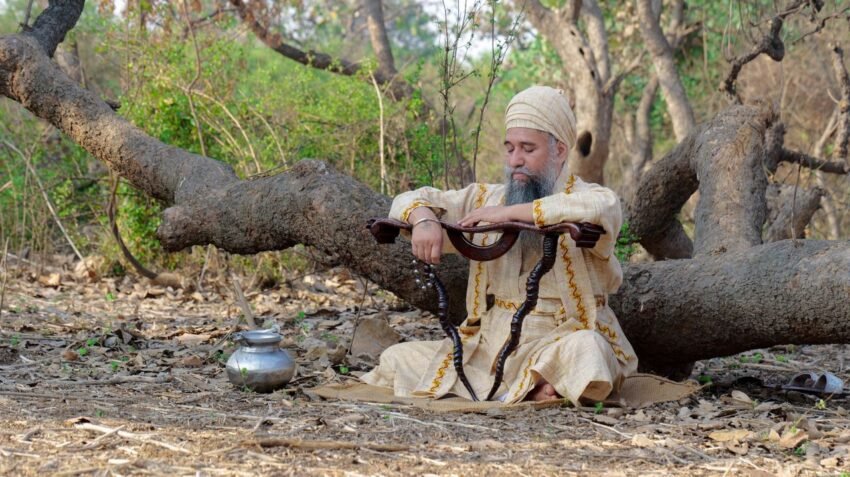
Between the 8th and 17th centuries CE, a sweeping spiritual and social transformation re-engineered the cultural fabric of the Indian subcontinent. Known as the Bhakti Movement, this popular socio-religious wave originated in Tamil South India through the devotional poetry of the Alvars (devotees of Vishnu) and Nayanars (devotees of Shiva) before spreading northwards into Maharashtra, Gujarat, Bengal, and the Gangetic heartland.
By prioritizing personal devotion (Bhakti) to a higher reality over rigid ritualism, caste distinctions, and institutional intermediaries, the movement democratized spirituality. It sparked a major literary revolution by shifting religious expression from elite Sanskrit to accessible regional languages.
1. Dual Streams of Devotion: Nirguna vs. Saguna
As the movement expanded across northern India during the medieval period, its practices split into two primary philosophical traditions:
                          BHAKTI MOVEMENT
                                 |
         +-----------------------+-----------------------+
         |                                               |
         v                                               v
  NIRGUNA SAMPRADAYA                              SAGUNA SAMPRADAYA
(Formless Absolute Reality)                     (Devotion to Personified Deity)
  * Rejects idols, temples, & caste.              * Reverses divine forms (Rama/Krishna).
  * Focuses on internal meditation (*Nama*).       * Employs idols, rituals, & kirtana.
  * Key Figures: Kabir, Guru Nanak.              * Key Figures: Mirabai, Tulsidas, Surdas.
| Philosophical Dimension | Nirguna Tradition | Saguna Tradition |
| Concept of God | Formless, transcendent reality (Brahman) beyond physical attributes. | Immanent, personal deity with specific form, name, and attributes. |
| Medium of Worship | Meditation, chanting the Divine Name (Nama-Simran), and inner discipline. | Image worship, temple rituals, devotional singing (Kirtan), and storytelling. |
| Social Stance | Uncompromising critique of caste, ritual purity, and priestly authority. | Reformist; works within traditional frameworks to make devotion accessible to all. |
| Prominent Saints | Sant Kabir, Guru Nanak, Ravidas, Dadu Dayal. | Mirabai, Chaitanya Mahaprabhu, Tulsidas, Surdas. |
2. Sant Kabir: The Iconoclast of Formless Truth
Living in 15th-century Varanasi, Sant Kabir stands as one of the most radical figures of the Nirguna tradition. Raised by a family of Muslim weavers (Julahas), Kabir synthesized elements of Islamic Sufism, Hindu Vedantic philosophy, and Nath Yogic discipline.
Key Teachings and Literary Form
Kabir expressed his philosophy through short, memorable couplets known as Dohas and longer songs called Sakhis and Padas, composed in Sadhukkadi (a vernacular blend of Hindi, Punjabi, Khari Boli, and Rajasthani):
-
Critique of Ritual Orthodoxy: Kabir challenged both Hindu priestly ritualism and Islamic dogmatism, emphasizing that true spirituality is found in ethical purity rather than external displays:“If worshipping stones can reveal God, I will worship a mountain… Better than these stones are the millstones of the house that grind flour for people to eat.”
-
Rejection of Caste Divisions: He taught that divine grace is accessible to all regardless of birth:“Do not ask about a saint’s caste; ask instead about his knowledge.”
His poetry was later compiled into the Bijak by his disciples, while a significant selection of his hymns was preserved in the Guru Granth Sahib, the holy scripture of Sikhism.
3. Mirabai: Unyielding Devotion to the Divine Form
In contrast to Kabir’s radical formless path, Mirabai (c. 1498–1547 CE), a Rajput princess from Mewar, represents the emotional height of the Saguna tradition centered on devotion to Lord Krishna (Giridhar Gopal).
                      MIRABAI'S DEVOTIONAL PATH
  +----------------------------------------------------------------+
  | Refusal of Social Expectations (Rejected royal domestic life) |
  +----------------------------------------------------------------+
                                 |
                                 v
  +----------------------------------------------------------------+
  | Spiritual Autonomy (Claimed Krishna as her true spouse)        |
  +----------------------------------------------------------------+
                                 |
                                 v
  +----------------------------------------------------------------+
  | Vernacular Composition (Composed lyrical padavalis in Marwari) |
  +----------------------------------------------------------------+
Social Rebellion through Madhurya Bhava
Mirabai’s devotional path (Madhurya Bhava, viewing the divine as the ultimate beloved) served as a direct challenge to the patriarchal social structures of 16th-century Rajasthan:
-
Defiance of Royal Mandates: Following the death of her husband, Prince Bhoj Raj, she refused to commit Sati and declined to observe courtly seclusion (Purdah).
-
Cross-Caste Discipleship: According to tradition, Mirabai accepted Sant Ravidas—a low-caste leather worker—as her spiritual teacher (Guru), demonstrating her disregard for caste hierarchies.
-
Lyrical Heritage: Her passionate, highly expressive lyrics (Padavalis)—composed in Rajasthani and Braj Bhasha—remain a cornerstone of Indian devotional music.
4. The Broader Cultural Renaissance
The Bhakti Movement served as a catalyst for cultural change across regional societies, leaving a lasting legacy in three primary areas:
A. The Flourishing of Vernacular Literature
The Bhakti poets abandoned elite Sanskrit in favor of local dialects spoken by the masses, giving birth to classical regional literatures across the subcontinent:
-
Tulsidas: Authored the Ramcharitmanas in Awadhi, bringing the Ramayana directly to common households.
-
Chaitanya Mahaprabhu: Popularized Gaudiya Vaishnavism and public group chanting (Nagar Kirtan) in Bengal using Bengali.
-
Tukaram, Namdev, and Dnyaneshwar: Developed the vibrant Varkari poetic tradition (Abhangas) in Marathi.
-
Narsinh Mehta: Composed foundational devotional poetry in Gujarati.
B. Social Reform and Democratic Ethos
By opening spiritual paths to women, lower castes, and working-class communities, the movement undermined the ideological dominance of birth-based hierarchies. Monasteries (Mathas), communal kitchens (Langars), and gathering halls (Satsangs) operated on egalitarian lines, providing space for social mobility and shared community life.
5. Enduring Legacy
The Bhakti Movement transformed Indian civilization by proving that spiritual devotion and social reform could go hand in hand. By blending personal faith with ethical living, Kabir, Mirabai, and their contemporaries built a cultural bridge across religious and social divides. Their poetry continues to shape South Asian literature, music, and social thought, standing as an enduring testament to human equality and spiritual freedom.
Category: History of India