In 1913, thousands of miles away from British India, Indian immigrants—predominantly Punjabi Sikh farmers, laborers, and ex-soldiers alongside political exiles—assembled in Astoria, Oregon, and San Francisco, California, to form the Pacific Coast Hindustan Association. Better known as the Ghadar Party, this revolutionary organization sought nothing less than the total overthrow of British imperial rule in India through an armed, multi-religious uprising.
Operating internationally across North America, Europe, East Asia, and the Middle East, the Ghadar Movement transformed Indian diaspora communities into active centers of anti-colonial resistance. It demonstrated that the demand for absolute freedom (Purna Swaraj) was not confined to mainland political organizations, but echoed across the globe.
1. Origins and Ideology of the Ghadar Movement
At the beginning of the 20th century, thousands of Indians migrated to the Pacific Coast of Canada and the United States to work in lumber mills, railway construction, and agriculture. There, they faced severe racial discrimination, exclusionary immigration laws, and violent anti-Asian riots.
Exiled intellectuals like Lala Har Dayal convinced emigrant workers that racial humiliation abroad was directly linked to political subjugation at home.
                    FOUNDATIONAL LEADERSHIP OF GHADAR
  +-------------------------------------------------------------------+
  | LALA HAR DAYAL (General Secretary & Ideologue)                    |
  | Former Oxford scholar who provided intellectual direction, writing|
  | fiery essays calling for global revolution.                       |
  +-------------------------------------------------------------------+
                                    |
                                    v
  +-------------------------------------------------------------------+
  | SOHAN SINGH BHAKNA (President)                                    |
  | Punjabi immigrant labor organizer who mobilized working-class    |
  | diaspora networks across the Pacific Northwest.                   |
  +-------------------------------------------------------------------+
                                    |
                                    v
  +-------------------------------------------------------------------+
  | KEY ASSOCIATES                                                    |
  | Tarak Nath Das, Barkatullah, Rash Behari Bose, Kartar Singh       |
  | Sarabha, and Vishnu Ganesh Pingle.                                |
  +-------------------------------------------------------------------+
The Ghadar Newspaper and Radical Secularism
From its San Francisco headquarters—named the Yugantar Ashram—the party began publishing its flagship weekly newspaper, The Ghadar (meaning “Rebellion”), in November 1913. Published in Urdu, Punjabi, Hindi, Gujarati, and Pashto, the masthead boldly declared its purpose:
“What is our name? Mutiny. What is our work? Mutiny. Where will it be breaking out? In India.”
The Ghadar philosophy was fiercely secular, pan-Indian, and anti-imperialist, explicitly prohibiting religious discrimination within its ranks and calling on Hindus, Muslims, and Sikhs to unite against colonial oppression.
2. Catalyst: The Komagata Maru Incident (1914)
In May 1914, a Japanese steamship, the Komagata Maru, chartered by a wealthy Punjabi businessman named Gurdit Singh, arrived in Vancouver carrying 376 Indian passengers (predominantly British subjects) seeking entry into Canada.
                      THE KOMAGATA MARU CRISIS
  +-------------------------------------------------------------------+
  | CANADIAN RESTRICTIONS                                             |
  | Canadian authorities enforce the "Continuous Journey Regulation,"|
  | designed specifically to block Asian immigration.                 |
  +-------------------------------------------------------------------+
                                    |
                                    v
  +-------------------------------------------------------------------+
  | TWO-MONTH STANDOFF IN VANCOUVER                                   |
  | Passengers are denied entry, food, and water for two months     |
  | before being forced out under naval escort.                       |
  +-------------------------------------------------------------------+
                                    |
                                    v
  +-------------------------------------------------------------------+
  | BUDGE BUDGE RIOT (CALCUTTA)                                       |
  | Upon returning to Bengal, British police open fire on the ship's  |
  | passengers, killing 20 and arresting over 200.                    |
  +-------------------------------------------------------------------+
The blatant discrimination of the Komagata Maru affair radicalized thousands of overseas Indians, convincing them that British subject status afforded zero legal rights or dignity, accelerating plans for an armed uprising.
3. World War I and the Attempted Armed Mutiny (1915)
The outbreak of World War I in August 1914 presented the Ghadar Party with an opportunity: with British imperial forces diverted to Western Europe, colonial military presence in India was severely depleted.
The Plan for a Pan-Indian Military Uprising
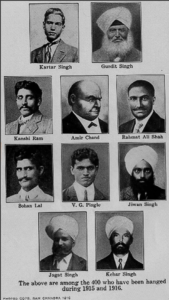
Thousands of Ghadarites abandoned their properties in North America and boarded ships bound for India to infiltrate native regiments of the British Indian Army.
Under the leadership of veteran revolutionary Rash Behari Bose and 19-year-old Kartar Singh Sarabha, the Ghadar network set February 21, 1915, as the date for a synchronized military uprising across cantonments in Firozpur, Lahore, Rawalpindi, and Meerut.
            THE 1915 GHADAR MUTINY & GERMAN ALLIANCE
  ===================================================================
                  BERLIN COMMITTEE & INTERNATIONAL NETWORKS
  ===================================================================
                                 |
           +---------------------+---------------------+
           |                                           |
           v                                           v
    [ GERMAN ARMS SHIPMENTS ]                 [ MILITARY INFILTRATION ]
  Ghadarites team up with German            Underground cells infiltrate
  diplomats ("Hindu-German Conspiracy")     cantonments across North India to
  to ship weapons via San Francisco.        trigger synchronized sepoy revolts.
Betrayal and Repression
Before the uprising could launch, a British spy named Kirpal Singh infiltrated the high command, informing colonial authorities. The British struck swiftly:
-
Pre-emptive Arrests: Martial law was declared across Punjab; key leaders were captured before weapons could be distributed.
-
Defence of India Act 1915: Emergency legislation was enacted, granting sweeping police powers to detain suspects without trial.
-
Lahore Conspiracy Trials: Over 40 revolutionaries—including Kartar Singh Sarabha and Vishnu Ganesh Pingle—were sentenced to death and executed, while hundreds were sentenced to life imprisonment at the Cellular Jail in the Andaman Islands (Kala Pani).
4. Global Footprint of Revolutionary Nationalism
Despite the collapse of the 1915 mutiny within India, revolutionary networks operated on an unprecedented international scale:
| Region / Alliance | Key Figures | Operational Strategy |
| Germany (Berlin Committee) | Virendranath Chattopadhyaya, Bhupendranath Datta | Formed the Indian Independence Committee in Berlin; coordinated German funding, arms shipments, and propaganda. |
| Afghanistan (Kabul) | Raja Mahendra Pratap, Maulana Barkatullah | Established the Provisional Government of India in Kabul (1915), seeking military aid from the Tsar of Russia and the Emir of Afghanistan. |
| Singapore | Sepoy Mustafa Hussain, Subedar Dunde Khan | Sparked the 1915 Singapore Mutiny; the 5th Light Infantry held the island for several days before being suppressed. |
| United States | M.N. Roy, Sailendra Nath Ghose | Prosecuted by the US government in the famous Hindu-German Conspiracy Trial (1917–1918) in San Francisco. |
5. Historical Significance and Legacy
Though the Ghadar Movement failed to achieve its immediate objective of inciting a widespread military revolt in 1915, its historical impact was profound:
-
Ideological Precursor to Radical Nationalism: The Ghadarites were the first Indian political group to demand complete independence (Purna Swaraj) without compromise, years before the Indian National Congress adopted the goal in 1929.
-
Pioneering Secularism: By maintaining absolute religious harmony across Sikh, Hindu, and Muslim cadres, the movement provided an early blueprint for secular anti-colonial resistance.
-
Inspiration for Future Revolutionaries: The martyrdom of figures like Kartar Singh Sarabha deeply inspired the next generation of revolutionary nationalists—most notably Bhagat Singh, who considered Sarabha his primary guru and role model.
Category: History of India