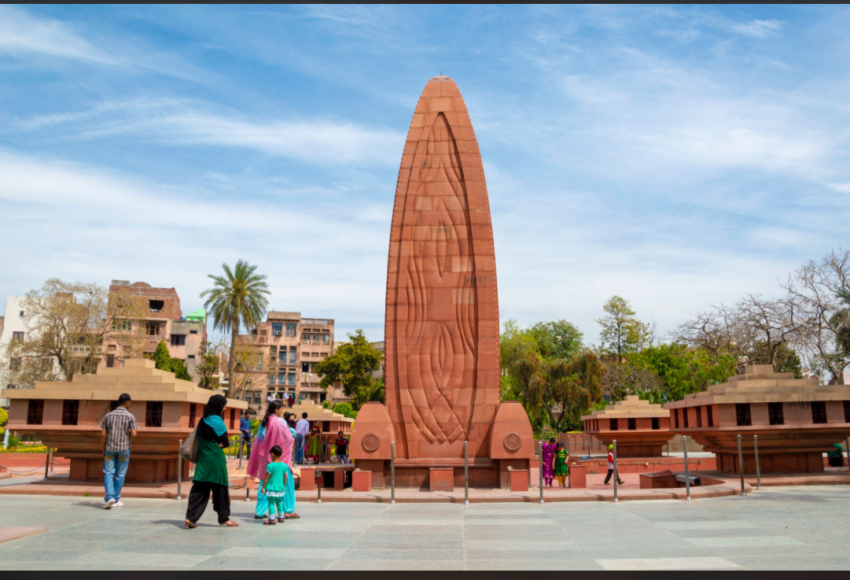
On April 13, 1919, the festival day of Baisakhi, British colonial troops opened fire on a large, unarmed gathering of men, women, and children inside Jallianwala Bagh, an enclosed public garden in Amritsar, Punjab. Executed under the orders of Brigadier-General Reginald Dyer, the slaughter marked one of the darkest atrocities of British imperial rule in India.
The massacre shattered Indian faith in British justice, dismantled the moral legitimacy of colonial rule, and transformed Mahatma Gandhi from a moderate reformer into an uncompromising opponent of the Empire. It galvanized pan-Indian solidarity and set the stage for the mass anti-colonial movements of the 1920s.
1. Background: The Rowlatt Act and Escalating Tensions
During World War I, Indian nationalist leaders supported the British war effort with men and resources, expecting significant political concessions toward self-governance afterward. Instead, the colonial government introduced the repressive Anarchical and Revolutionary Crimes Act of 1919, popularly known as the Rowlatt Act.
                    THE ROWLATT ACT ("BLACK ACT")
  +-------------------------------------------------------------------+
  | AUTHORITARIAN POWERS                                              |
  | Allowed detention of political suspects without trial for up to   |
  | two years, suppressed press freedoms, and banned public assemblies.|
  +-------------------------------------------------------------------+
                                    |
                                    v
  +-------------------------------------------------------------------+
  | POPULAR INDIAN DENUNCIATION                                       |
  | Summarized by the public slogan:                                  |
  | "No Dalil, No Vakil, No Appeal" (No argument, no lawyer, no appeal).|
  +-------------------------------------------------------------------+
                                    |
                                    v
  +-------------------------------------------------------------------+
  | ROWLATT SATYAGRAHA                                                |
  | Mahatma Gandhi organized nationwide hartals (strikes), strikes,   |
  | and non-violent demonstrations starting in March 1919.            |
  +-------------------------------------------------------------------+
Unrest in Punjab
Punjab experienced acute socio-economic distress due to wartime forced military recruitment and high inflation. On April 10, 1919, two popular nationalist leaders in Amritsar—Dr. Saifuddin Kitchlew and Dr. Satyapal—were secretly arrested and deported by local authorities.
When peaceful protesters marched to demand their release, military guards opened fire, killing several demonstrators. Clashes erupted across Amritsar, resulting in damaged government property and the death of five Europeans. In response, the administration handed control of the city to Brigadier-General Reginald Dyer, who imposed a strict ban on public gatherings under martial law.
2. The Tragedy of April 13, 1919
On the afternoon of April 13, thousands of villagers gathered at Jallianwala Bagh to celebrate the traditional festival of Baisakhi and peacefully protest the arrest of Kitchlew and Satyapal. Many visitors coming from surrounding rural areas were unaware of Dyer’s ban on public assemblies.
                    THE GEOGRAPHY OF THE SLAUGHTER
  +-------------------------------------------------------------------+
  | JALLIANWALA BAGH SETTING                                          |
  | A six-acre walled compound surrounded by high residential walls,   |
  | accessible only through one narrow passage.                       |
  +-------------------------------------------------------------------+
                                    |
                                    v
  +-------------------------------------------------------------------+
  | THE BLOCKADE AND UNPROVOKED FIRE                                  |
  | General Dyer deployed 50 soldiers armed with Lee-Enfield rifles,   |
  | blocked the sole exit, and ordered immediate firing without       |
  | issuing any verbal warning or dispersal order.                    |
  +-------------------------------------------------------------------+
The Brutality of the Attack
For approximately 10 to 15 minutes, troops fired 1,650 rounds into the panicked crowd until their ammunition was exhausted.
-
Trapped Mass: With the main exit blocked, victims attempted to scale the high perimeter walls or jumped into the compound’s open water well (the Martyrs’ Well).
-
Casualties: While the official official British report (the Disorders Inquiry Committee) claimed 379 dead and ~1,200 wounded, independent investigations led by the Indian National Congress estimated the death toll at over 1,000 casualties.
-
Post-Massacre Atrocities: Dyer subsequently enforced humiliating martial law orders in Amritsar, including the notorious “Crawling Order,” forcing Indian citizens to crawl on their bellies down a street where a British missionary had been attacked.
3. Immediate Aftermath and Official Reactions
The massacre sent shockwaves across India and internationally, drawing sharp divisions between imperial authorities and the nationalist movement:
                  REACTIONS TO THE MASSACRE
  ===================================================================
                  CONTRASTING RESPONSES (1919–1920)
  ===================================================================
                                 |
           +---------------------+---------------------+
           |                                           |
           v                                           v
    [ NATIONALIST OUTRAGE ]                   [ BRITISH COVER-UP ]
  • Rabindranath Tagore renounces his         • Hunter Commission exonerates
    British Knighthood in protest.              Dyer from criminal murder charges.
  • Mahatma Gandhi returns his                • UK House of Lords passes a vote
    *Kaiser-i-Hind* war medal.                  praising Dyer's "decisive action."
The Hunter Committee (1919)
The British government appointed the Disorders Inquiry Committee (headed by Lord Hunter) to investigate the events. While the committee censured Dyer for “excessive use of force,” it levied no formal criminal charges or legal prosecution. Dyer was relieved of his command and recalled to Britain, where imperial sympathizers presented him with a sword of honor and a substantial purse collected by the Daily Mail.
4. Impact on National Consciousness and the Freedom Struggle
The Jallianwala Bagh Massacre served as a decisive turning point in South Asian history, fundamentally altering the trajectory of anti-colonial resistance:
| Dimension | Historical Impact & Consequence |
| Shift in Gandhi’s Philosophy | Transformed Gandhi from a believer in British constitutional goodwill into a radical opponent of colonial rule, leading directly to his launch of the Non-Cooperation Movement (1920–1922). |
| Rise of Revolutionary Nationalism | Inspired young revolutionaries—most notably Udham Singh, who witnessed the aftermath as a teenager and later assassinated Sir Michael O’Dwyer (Lieutenant-Governor of Punjab during 1919) in London in 1940. |
| Loss of Moral Legitimacy | Permanently shattered the myth of the “civilizing mission” (Pax Britannica), alienating moderate liberals who had previously favored gradual reform within the Empire. |
| Hindu-Muslim-Sikh Solidarity | Unified diverse religious communities against colonial violence, strengthening the joint Khilafat and Non-Cooperation movement. |
5. Historical Significance
Jallianwala Bagh exposed the underlying reliance of the colonial state on coercive violence over popular consent. By transforming passive discontent into active mass resistance, the blood spilled at Amritsar in 1919 unified the nation under a shared identity of struggle, establishing that self-rule (Swaraj) was the only acceptable outcome for the Indian national movement.
Category: History of India