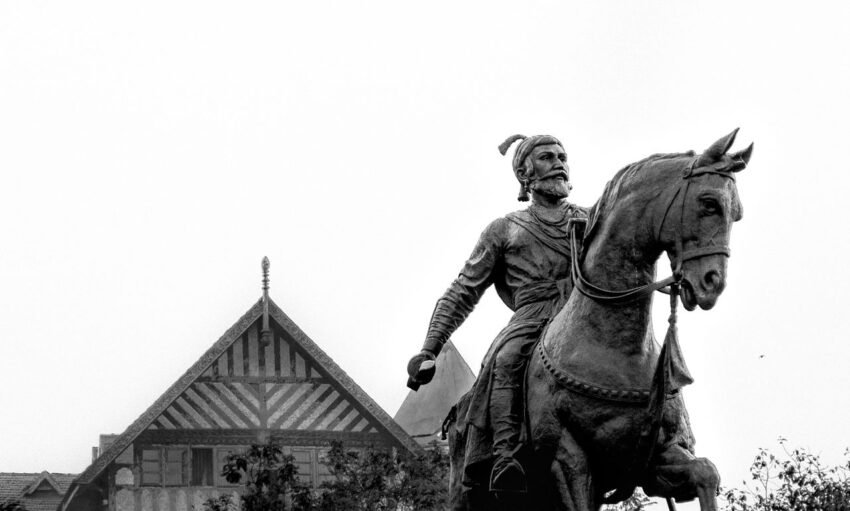
In the mid-17th century, as the Mughal Empire reached its territorial zenith and the Deccani Sultanates held sway over Western India, a revolutionary political force emerged from the rugged terrain of the Western Ghats (Sahyadri range). Chhatrapati Shivaji Maharaj (1630–1680 CE) transformed scattered Maratha chieftaincies into a sovereign state, founding the Maratha Empire (Hindavi Swarajya).
Faced with numerically and technologically superior armies, Shivaji pioneered Ganimi Kava—a sophisticated system of irregular guerrilla warfare that used the natural geography of Maharashtra as a strategic equalizer.
1. The Anatomy of Ganimi Kava (Guerrilla Warfare)
The term Ganimi Kava translates to “enemy-deceiving tactics.” Rather than engaging in traditional, open-field battles against heavy Mughal or Deccani cavalry, Shivaji developed an asymmetrical doctrine based on speed, mobility, terrain advantage, and psychological operations.
                   THE PRINCIPLES OF GANIMI KAVA
  +-------------------------------------------------------------------+
  | MOBILITY OVER MASS                                                |
  | Light, unencumbered cavalry (*Bargirs* and *Silahdars*) moving    |
  | swiftly across rugged mountain passes without heavy supply trains. |
  +-------------------------------------------------------------------+
                                    |
                                    v
  +-------------------------------------------------------------------+
  | TERRAIN EXPLOITATION                                              |
  | Luring heavy enemy formations into narrow valley choke-points and |
  | dense forests where superior numbers count for nothing.           |
  +-------------------------------------------------------------------+
                                    |
                                    v
  +-------------------------------------------------------------------+
  | SURPRISE & DISRUPT                                                |
  | Ambushes, night raids, and rapid retreats before enemy forces     |
  | can organize a counter-attack.                                    |
  +-------------------------------------------------------------------+
Strategic Execution in Key Conflicts
-
The Battle of Pratapgad (159 CE): When the Bijapur general Afzal Khan led a massive army against Shivaji, Shivaji enticed him into the dense, forested terrain at the foot of Pratapgad Fort. After neutralizing Khan during a personal diplomatic summit, Maratha forces launched a planned ambush on the trapped Bijapuri army, destroying its command structure.
-
The Night Raid on Shaista Khan (1663 CE): Mughal general Shaista Khan occupied Pune with thousands of troops. Shivaji, accompanied by a small strike force of 400 soldiers, infiltrated Khan’s fortified residence (Lal Mahal) under cover of darkness, injuring the general and forcing the Mughal garrison to retreat.
2. The Hill Fort Infrastructure (Killa System)
Fortresses served as the tactical anchors of Maratha power. Shivaji built, captured, or renovated over 300 forts across Maharashtra, establishing a defensive network that dominated trade routes and mountain passes.
Classification and Security Blueprint
Maratha forts were categorized into three distinct geographical types:
-
Giri Durg (Hill Forts): Perched on high Sahyadri peaks (e.g., Rajgad, Raigad, Torna), serving as command hubs and supply depositories.
-
Jala Durg (Sea Forts): Constructed along the Konkan coastline (e.g., Sindhudurg, Vijaydurg) to defend maritime borders against Portuguese, British, and Siddi naval forces.
-
Bhu Durg (Land Forts): Located in lowlands to control agricultural routes.
                   HILL FORT DEFENSIVE BLUEPRINT
  +-------------------------------------------------------------------+
  | COMMAND DIVISION                                                  |
  | Three independent officers shared power to prevent betrayal:       |
  | 1. Havaldar (Military Commandant - controlled fort gates)         |
  | 2. Sabnis (Administrative Officer - managed accounts and payroll)|
  | 3. Karkhannis (Quartermaster - maintained grain and ammunitions)  |
  +-------------------------------------------------------------------+
3. The Ashta Pradhan: Administrative Genius
When Shivaji was crowned Chhatrapati at Raigad in 1674 CE, he formalized an administrative framework designed to transition the state from a wartime resistance force into a structured kingdom. Central to this was the Ashta Pradhan—a council of eight ministers reporting directly to the king.
| Title | Function | Primary Duties |
| Peshwa | Prime Minister | Overall administration and state policy execution. |
| Amatya | Finance Minister | Managed imperial accounts, revenue, and audits. |
| Sachiv | Royal Secretary | Handled imperial correspondence and royal edicts. |
| Mantri | Interior Minister | Overhauled intelligence networks and record-keeping. |
| Senapati | Commander-in-Chief | Led military forces and army organization (Sarnaubat). |
| Sumant | Foreign Minister | Managed diplomatic relations and foreign affairs. |
| Nyayadhish | Chief Justice | Administered civil and military law. |
| Panditrao | High Priest | Overseen religious affairs, charity, and honors. |
4. Revenue Administration and Taxation
Shivaji replaced the abusive feudal farming system with a direct revenue structure modeled on the reforms of Malik Ambar and Sher Shah Suri:
-
Direct Assessment: Land was surveyed using a standardized measuring rod (Kathi). Tax rates were fixed at 33% to 40% of the actual agricultural yield, payable in cash or grain.
-
Abolition of Jagirdari: To prevent military commanders from establishing independent fiefdoms, officers were paid salaries directly from the state treasury rather than through hereditary land grants (Jagirs).
-
External Revenue (Chauth and Sardeshmukhi): Taxes levied on territories outside the core Maratha state (Swarajya) in exchange for protection against Maratha raids:
-
Chauth: A 25% tax on land revenue.
-
Sardeshmukhi: An additional 10% tax claimed by Shivaji as the hereditary overlord (Sardeshmukh) of the region.
-
5. Enduring Legacy
Chhatrapati Shivaji Maharaj built an administrative and military architecture that outlasted his death in 1680 CE. His tactics enabled the Marathas to withstand the 26-year Deccan Campaign waged by Mughal Emperor Aurangzeb.
By prioritizing direct governance, naval strength, merit-based appointments, and Ganimi Kava, Shivaji laid the groundwork for the Maratha Confederacy, which expanded across central and northern India during the 18th century to become the dominant power in South Asia prior to British expansion.
Category: History of India