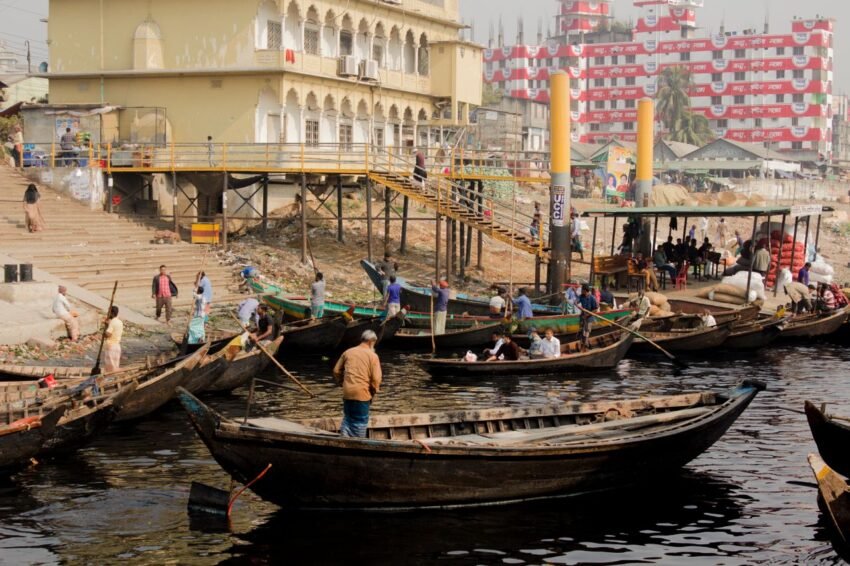
On October 16, 1905, the British Raj enacted the Partition of Bengal, dividing the largest and most politically active province of British India into two separate administrative units. Engineered by the Viceroy of India, Lord Curzon, the decision was publicly framed as a measure to improve administrative efficiency. In reality, it was a calculated political move designed to weaken the growing tide of Indian nationalism centered in Bengal by dividing the population along communal lines.
Rather than pacifying the region, the partition ignited an unprecedented wave of anti-colonial resistance known as the Swadeshi Movement. Marking the transition of the Indian national movement from petition-based politics to direct popular action, the movement pioneered tools of economic self-reliance, cultural revival, and mass mobilization that shaped the struggle for Indian independence.
1. Background: Lord Curzon’s Divide-and-Rule Strategy
By the early 20th century, the Bengal Presidency—encompassing modern-day West Bengal, Bangladesh, Bihar, Jharkhand, and Odisha—was home to nearly 78 million people. The educated Bengali middle class (Bhadralok) formed the intellectual nucleus of the Indian National Congress (INC) and was increasingly critical of British policies.
                    MOTIVATIONS BEHIND THE PARTITION
  +-------------------------------------------------------------------+
  | OFFICIAL BRITISH STANCE                                           |
  | Administrative overload: Bengal was too vast for a single         |
  | Lieutenant-Governor to govern efficiently.                        |
  +-------------------------------------------------------------------+
                                    |
                                    v
  +-------------------------------------------------------------------+
  | ACTUAL POLITICAL MOTIVE                                           |
  | "Divide and Rule": Break Bengali linguistic unity and engineer    |
  | a Hindu-Muslim religious divide across the province.             |
  +-------------------------------------------------------------------+
The Plan of Division
Under Curzon’s plan:
-
Eastern Bengal and Assam: Created with a Muslim-majority population, with its capital at Dacca (Dhaka).
-
Western Bengal, Bihar, and Orissa: Retained as a Hindu-majority region, with its capital at Calcutta (Kolkata).
By making Bengalis a linguistic minority in the western province and fostering a regional religious split, the colonial administration sought to shatter the political solidarity of the region.
2. Day of Mourning and Mass Mobilization
The partition officially took effect on October 16, 1905. The day was observed throughout Bengal as a national day of mourning.
-
Raksha Bandhan as Political Unity: Spearheaded by Nobel laureate Rabindranath Tagore, thousands of Hindus and Muslims tied yellow silk threads (Rakhi) on one another’s wrists as a symbol of the unbreakable unity of Bengal.
-
Protest Rallies and Processions: People walked barefoot to the Hooghly River to bathe, singing patriotic songs such as Tagore’s “Amar Shonar Bangla” (my golden Bengal—now the national anthem of Bangladesh) and Bankim Chandra Chattopadhyay’s “Vande Mataram”.
-
Fasting and General Strikes: Shops were closed, and business came to a standstill across major urban centers.
3. The Swadeshi and Boycott Strategy
The resistance quickly crystallized into a two-pronged national strategy led by the Extremist faction of the Indian National Congress—notably the Lal-Bal-Pal trio: Lala Lajpat Rai (Punjab), Bal Gangadhar Tilak (Maharashtra), and Bipin Chandra Pal (Bengal), alongside Aurobindo Ghose.
                  THE TWO PILLARS OF THE MOVEMENT
  ===================================================================
                       ANTI-COLONIAL RESISTANCE
  ===================================================================
                                 |
           +---------------------+---------------------+
           |                                           |
           v                                           v
    [ BOYCOTT MOVEMENT ]                       [ SWADESHI MOVEMENT ]
  Rejection of British goods, cloth,          Promotion of indigenous industries,
  schools, courts, and government title.       national education, and self-reliance.
Key Dimensions of the Swadeshi Economic Push
-
Indigenous Industries: Indian entrepreneurs launched local enterprises to supply essential goods. Bengal Chemicals and Pharmaceutical Works was established by Acharya P.C. Ray, while Indian-owned cotton mills, soap factories, and matchmaking units flourished across the country.
-
National Education: To counter colonial influence in schools, the National Council of Education was founded in 1906, leading to the creation of institutions like the Bengal National College (with Aurobindo Ghose as its first principal).
-
Cultural Revival: Folk theater (Jatra), patriotic poetry, and art championed national identity. Artists like Abanindranath Tagore painted Bharat Mata (Mother India) as a serene, spiritual deity, breaking away from Western artistic conventions.
4. Spread Beyond Bengal and the INC Split
Though centered in Bengal, the Swadeshi Movement resonated across the entire Indian subcontinent:
-
Maharashtra: Led by Bal Gangadhar Tilak, who used the Ganesh Utsav and Shivaji Utsav festivals to mobilize public support.
-
Punjab: Led by Lala Lajpat Rai and Ajit Singh.
-
Madras Presidency: Spearheaded by V.O. Chidambaram Pillai, who founded the Swadeshi Steam Navigation Company in Tuticorin to challenge the British shipping monopoly.
The Surat Split (1907)
Tensions escalated within the Indian National Congress between the Moderates (led by Gopal Krishna Gokhale), who favored constitutional petitions, and the Extremists, who advocated for extending the boycott to full civil disobedience. This ideological rift culminated in a open rupture at the Surat Session of 1907, temporarily dividing the national movement.
5. Rise of Revolutionary Nationalism and the 1911 Annulment
Faced with severe government repression, bans on public gatherings, and police violence, a section of the youth turned to secret societies and revolutionary action to challenge colonial authority.
-
Secret Societies: Organizations like the Anushilan Samiti (founded in Dhaka and Calcutta) and the Jugantar group organized underground cells to train youth in arms and manufacture explosives.
-
Alipore Bomb Case (1908): Following an attempted assassination of a controversial magistrate by young revolutionaries Kudiram Bose and Prafulla Chaki, major leaders including Aurobindo Ghose were arrested and tried.
                    TIMELINE OF THE BENGAL PARTITION
  +-------------------------------------------------------------------+
  | JULY 1905: Lord Curzon announces the Bengal Partition plan.       |
  +-------------------------------------------------------------------+
                                    |
                                    v
  +-------------------------------------------------------------------+
  | AUGUST 1905: Formal Swadeshi resolution passed in Calcutta.       |
  +-------------------------------------------------------------------+
                                    |
                                    v
  +-------------------------------------------------------------------+
  | OCTOBER 16, 1905: Partition takes effect; day observed as mourning.|
  +-------------------------------------------------------------------+
                                    |
                                    v
  +-------------------------------------------------------------------+
  | DECEMBER 1911: Delhi Durbar; King George V annuls the Partition.   |
  +-------------------------------------------------------------------+
The 1911 Annulment
Unable to quell the persistent unrest and economic damage caused by the boycott, the British government relented. At the Delhi Durbar in December 1911, King George V formally announced:
-
Annulment of the Partition of Bengal: reuniting the Bengali-speaking divisions.
-
Transfer of the Imperial Capital: shifting the capital of British India from Calcutta to Delhi to distance the administration from Bengal’s political activism.
6. Historical Significance and Legacy
The Partition of Bengal and the Swadeshi Movement represented a decisive turning point in South Asian history. By proving that popular mobilization and economic resistance could force policy reversals from the colonial state, the movement laid the operational groundwork for the mass movements led by Mahatma Gandhi in the decades that followed.
Category: History of India