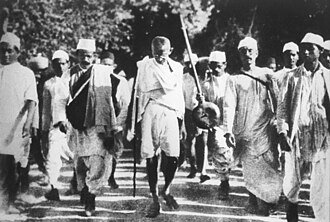
On March 12, 1930, Mahatma Gandhi set out from his Sabarmati Ashram in Ahmedabad accompanied by 78 chosen followers on a 240-mile trek to the coastal village of Dandi, Gujarat. The objective of this march was to break the British imperial monopoly on salt—a humble, universal commodity essential to every Indian household regardless of class, caste, or creed.
The Salt March (Dandi Satyagraha) launched the Civil Disobedience Movement, transforming non-violent civil resistance from a philosophical concept into an effective strategy for political action. By picking up a handful of natural salt from the shores of Dandi on April 6, 1930, Gandhi challenged the moral authority of the British Empire and brought the Indian freedom struggle to the forefront of global news.
1. Background: The Lahore Declaration and the Choice of Salt
Following the disappointment of the Simon Commission (1928) and the rejection of the Nehru Report, the Indian National Congress held its historic Lahore Session in December 1929 under the presidency of Jawaharlal Nehru. There, the INC passed the landmark Purna Swaraj resolution, declaring complete independence—rather than dominion status—as the ultimate goal of the national movement.
To operationalize Purna Swaraj, the Congress authorized Gandhi to launch a nation-wide Civil Disobedience campaign.
                    WHY SALT AS THE SYMBOL OF RESISTANCE?
  +-------------------------------------------------------------------+
  | UNIVERSAL RELEVANCE                                               |
  | Salt was consumed daily by every rich and poor person, making it |
  | a non-divisive, human issue that transcended social barriers.     |
  +-------------------------------------------------------------------+
                                    |
                                    v
  +-------------------------------------------------------------------+
  | REPRESSIVE COLONIAL TAXATION                                      |
  | The British Salt Act of 1882 made it a criminal offense for       |
  | Indians to collect, manufacture, or sell salt without a license,  |
  | imposing a steep tax on a basic necessity of life.                |
  +-------------------------------------------------------------------+
                                    |
                                    v
  +-------------------------------------------------------------------+
  | MORAL INJUSTICE                                                   |
  | Taxing a natural gift of the ocean used by the poorest peasants   |
  | starkly exposed the exploitative nature of British colonial rule.  |
  +-------------------------------------------------------------------+
Prior to launching the march, Gandhi sent an 11-point demand letter to the Viceroy, Lord Irwin, offering to forgo civil disobedience if taxes were reduced and political prisoners released. When Irwin dismissed the letter, Gandhi famously remarked: “On bended knees I asked for bread and I have received a stone instead.”
2. The March to Dandi (March 12 – April 6, 1930)
The 24-day march from Sabarmati to Dandi was a masterclass in political communication and mass mobilization.
                  THE ROUTE TO DANDI (240 MILES)
  ===================================================================
             24 DAYS • 4 DISTRICTS • HUNDREDS OF VILLAGES
  ===================================================================
                                 |
           +---------------------+---------------------+
           |                                           |
           v                                           v
    [ DAYTIME MOBILIZATION ]                   [ NIGHTTIME ADDRESSES ]
  Gandhi and the 78 Satyagrahis walked      Villagers gathered in thousands.
  an average of 10–12 miles a day through    Local officials resigned from their
  scores of Gujarati villages.               government posts in solidarity.
At every stop, Gandhi addressed large crowds, explaining the ethics of Satyagraha (truth-force), advocating for the eradication of untouchability, promoting village industries (Khadi), and urging citizens to disobey unjust colonial laws without resorting to violence.
The Climax at Dandi
On the morning of April 6, 1930, after offering morning prayers, Gandhi walked to the Arabian Sea shore at Dandi, scooped up a lump of natural salty mud, and boiled it to produce illegal salt. With this simple act, he officially broke the law, signaling the start of nationwide civil disobedience.
“With this salt, I am shaking the foundations of the Empire.”— Mahatma Gandhi, April 6, 1930
3. Nationwide Escalation and Regional Manifestations
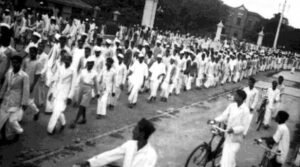
Gandhi’s act sparked widespread non-violent defiance across the Indian subcontinent. Millions of people joined in manufacturing illegal salt, boycotting British cloth and liquor, and refusing to pay land revenues.
                   PAN-INDIAN CIVIL DISOBEDIENCE
  ===================================================================
              REGIONAL LEADERSHIP & MASS DEFICANCE
  ===================================================================
                                 |
     +-------------------+-------+-------+-------------------+
     |                   |               |                   |
     v                   v               v                   v
  [ TAMIL NADU ]     [ MALABAR ]    [ NWFP (PESHAWAR) ]   [ BENGAL & BHAR ]
  C. Rajagopalachari K. Kelappan    Khan Abdul Ghaffar    Chowkidari tax refusal
  led Vedaranyam     led Calicut-   Khan ("Frontier       and salt manufacturing
  Salt March.        Payyanur march. Gandhi") & *Khudai    along coastal regions.
                                     Khidmatgars*.
Key Regional Campaigns
-
North-West Frontier Province (NWFP): Khan Abdul Ghaffar Khan (affectionately known as the “Frontier Gandhi”) led the non-violent Khudai Khidmatgars (“Servants of God,” or Red Shirts). During the Qissa Khwani Bazaar massacre in Peshawar, British troops opened fire on non-violent protesters, but royal Indian troops (Garhwal Rifles) famously refused to fire on their unarmed countrymen.
-
Women’s Participation: The Civil Disobedience Movement witnessed unprecedented participation by women. Prominent leaders like Sarojini Naidu, Kamaladevi Chattopadhyay, Kasturba Gandhi, and Rajkumari Amrit Kaur spearheaded the picketing of foreign cloth shops and government liquor vendors.
-
Dharasana Salt Works Raid (May 1930): Following Gandhi’s arrest on May 4, Sarojini Naidu and Manilal Gandhi led 2,500 non-violent Satyagrahis to peacefully raid the government salt depot at Dharasana, Gujarat. Unarmed marchers walked forward in orderly waves, making no attempt to defend themselves as British-led police struck them with steel-shod lathis (truncheons). American journalist Webb Miller reported the brutal repression to international news outlets, causing global outrage.
4. Repression and the Gandhi-Irwin Pact (1931)
Faced with paralyzed administration and international condemnation, the colonial state responded with severe repression. Over 60,000 political activists were imprisoned, public assemblies were banned, and nationalist presses were censored.
                    TIMELINE OF THE CIVIL DISOBEDIENCE
  +-------------------------------------------------------------------+
  | JANUARY 1930: Congress adopts Declaration of Independence.        |
  +-------------------------------------------------------------------+
                                    |
                                    v
  +-------------------------------------------------------------------+
  | MARCH–APRIL 1930: Dandi Salt March and breaking of the salt law.  |
  +-------------------------------------------------------------------+
                                    |
                                    v
  +-------------------------------------------------------------------+
  | MAY 1930: Arrest of Gandhi; Dharasana Satyagraha led by Sarojini Naidu.|
  +-------------------------------------------------------------------+
                                    |
                                    v
  +-------------------------------------------------------------------+
  | MARCH 1931: Signing of the Gandhi-Irwin Pact; campaign suspended. |
  +-------------------------------------------------------------------+
The Gandhi-Irwin Pact (March 5, 1931)
Realizing that force alone could not crush the movement, Lord Irwin initiated negotiations with Gandhi. This culminated in the Gandhi-Irwin Pact, under which:
-
The Congress agreed to suspend the Civil Disobedience Movement.
-
Gandhi agreed to attend the Second Round Table Conference in London as the sole representative of the INC.
-
The British government agreed to release all non-violent political prisoners, allow coastal residents to manufacture salt for personal use, and permit peaceful picketing of liquor and foreign cloth shops.
5. Overview of the Civil Disobedience Movement
| Parameter | Details & Key Dynamics |
| Primary Catalyst | Taxation on salt; refusal of British government to accept the 11-point demand; Purna Swaraj goal. |
| Core Method | Direct breach of colonial laws (Civil Disobedience), non-payment of taxes, picketing, and economic boycott. |
| Key Leaders | Mahatma Gandhi, Sarojini Naidu, C. Rajagopalachari, Khan Abdul Ghaffar Khan, Jawaharlal Nehru, Vallabhbhai Patel. |
| Demographic Reach | Deep participation of women, urban middle class, rural peasantry, students, and merchant communities. |
| Global Media Reach | Extensive coverage by international journalists (e.g., Webb Miller, Time Magazine) brought global attention to the Indian independence struggle. |
6. Historical Significance and Legacy
The Salt March transformed the dynamics of anti-colonial resistance in several key ways:
-
Strategic Genius of Direct Action: Gandhi proved that an ordinary item of daily consumption could become a powerful lever to challenge an imperial power.
-
Global Public Opinion: The non-violent conduct of Satyagrahis exposed the stark moral contrast between peaceful civil protesters and colonial violence, shifting international public opinion (especially in Britain and the United States) in favor of Indian self-determination.
-
Template for Future Rights Movements: The strategic framework of the Salt March inspired non-violent civil rights movements worldwide, most notably the American Civil Rights Movement led by Dr. Martin Luther King Jr. in the 1950s and 1960s.
Category: History of India