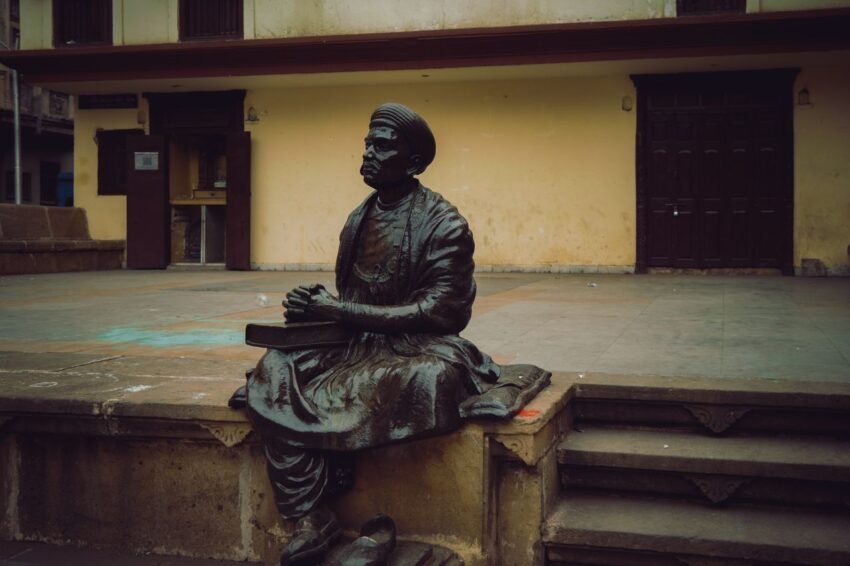
During the early 19th century, against the backdrop of British political expansion and socio-economic transformation, Bengal experienced a profound intellectual, cultural, and spiritual awakening known as the Bengal Renaissance. At the forefront of this movement stood Raja Ram Mohan Roy (1772–1833 CE), widely revered as the “Father of Modern India” and the “Father of the Bengal Renaissance.”
Recognizing that social degeneration and religious orthodoxy hindered political and moral progress, Roy dedicated his life to eradicating inhuman customs, defending women’s rights, promoting rational scientific education, and establishing a monotheistic framework for modern Hinduism through the Brahmo Samaj.
1. Early Life and Intellectual Evolution
Born into an orthodox Bengali Brahmin family in Radhanagar, Bengal, Ram Mohan Roy demonstrated an extraordinary aptitude for languages and cross-cultural philosophy.
                    INTELLECTUAL INFLUENCES ON ROY
  +-------------------------------------------------------------------+
  | LINGUISTIC MASTERY                                                |
  | Fluent in Sanskrit, Persian, Arabic, English, Hebrew, and Greek.   |
  +-------------------------------------------------------------------+
                                    |
                                    v
  +-------------------------------------------------------------------+
  | SYNTHETIC PHILOSOPHY                                              |
  | Combined Vedantic monism with Islamic monotheism, Western         |
  | rationalism, and Christian ethical principles.                    |
  +-------------------------------------------------------------------+
                                    |
                                    v
  +-------------------------------------------------------------------+
  | EARLY CRITIQUE OF ORTHODOXY                                       |
  | Published *Tuhfat-ul-Muwahhidin* ("A Gift to Monotheists") in     |
  | Persian in 1803, denouncing idol worship and superstition.        |
  +-------------------------------------------------------------------+
Roy argued that original Hindu scriptures—specifically the Upanishads and the Vedanta—preached monotheism (Ekeshwaravada) and that corrupt priestcraft, idolatry, and rigid rituals were later distortions added to subjugate the masses.
2. The Campaign Against Sati and the Crusade for Women’s Rights
Raja Ram Mohan Roy’s most enduring legacy was his passionate, relentless crusade against Sati—the barbaric practice of burning widows alive on their husbands’ funeral pyres. Driven by the tragic personal experience of witnessing his sister-in-law forced onto a pyre, Roy launched a multi-pronged assault against the custom:
-
Scriptural Debunking: He wrote extensive pamphlets citing ancient Sanskrit texts to prove that Sati was neither mandatory nor recommended in original Hindu scriptures.
-
Public Mobilization: He organized patrols along the banks of the Hooghly River to prevent forced immolations and drafted petitions to government officials.
-
Legislative Victory: In 1829, working alongside Governor-General Lord William Bentinck, Roy secured the passage of the Sati Abolition Regulation Act, declaring the practice illegal and punishable as culpable homicide across British India.
Broader Advocacy for Women
Roy was among the earliest Indian thinkers to recognize that a society cannot progress while isolating and oppressing women:
-
Right to Property: Advocated for legal reforms granting widows and daughters hereditary property rights.
-
Anti-Polygamy & Child Marriage: Strongly denounced child marriage, polygamy, and the ill-treatment of widows.
-
Female Education: Promoted girls’ education as a fundamental prerequisite for national modernization.
3. Foundation and Philosophy of the Brahmo Samaj
In 1815, Roy founded the Atmiya Sabha (Society of Friends) to discuss monotheistic ideas. This evolved into the Brahmo Sabha in 1828, later renamed the Brahmo Samaj (Society of God).
                      CORE TENETS OF THE BRAHMO SAMAJ
  ===================================================================
                       MONOTHEISTIC & REFORMIST
  ===================================================================
                                 |
           +---------------------+---------------------+
           |                     |                     |
           v                     v                     v
    [ ONE GOD ]          [ NO IDOLATRY ]       [ REASON & SCRIPTURE ]
  Worship of the one    Rejection of images,   Scriptures are subject
  Supreme Being without sacrificial rituals,   to human reason; no single
  caste distinction.    and priestcraft.       book is infallible.
The Brahmo Samaj established a universal, non-sectarian platform where individuals of any background could gather for prayer, readings from the Upanishads, and moral discourses without idol worship or animal sacrifices.
4. Educational Reforms and Modern Journalism
Roy recognized that long-term social transformation required combining traditional Eastern philosophy with modern Western science and literature.
-
Anglicist-Orientalist Education: Supported the introduction of modern English education in India. In collaboration with Scottish philanthropist David Hare, he founded the Hindu College (now Presidency University) in Calcutta in 1817.
-
Vedanta College (1825): Established an institution offering courses in both traditional Indian learning and Western natural and social sciences.
-
Pioneer of Indian Journalism: Published periodicals in multiple languages to build an informed public opinion:
-
Sambad Kaumudi (Bengali) — Advocated social reform and civil rights.
-
Mirat-ul-Akbar (Persian) — Discussed international affairs, socio-political issues, and legal critique.
-
5. Evolution of the Brahmo Samaj Movement
Following Ram Mohan Roy’s death in Bristol, England, in 1833, the Brahmo Samaj was led and expanded by subsequent reform leaders who broadened its social and geographical reach:
| Leader | Key Contributions | Major Split / Movement |
| Debendranath Tagore | Joined in 1842; revitalized the Samaj through the Tattwabodhini Sabha; stressed Vedantic heritage. | Led the Adi Brahmo Samaj after the 1866 split. |
| Keshub Chandra Sen | Joined in 1857; popularized the movement outside Bengal; incorporated Christian/universalist ideas. | Founded the Brahmo Samaj of India (1866) and later the Naba Bidhan (1881). |
| Ananda Mohan Bose & Shivnath Shastri | Formed a radical group focused on social justice, women’s suffrage, and anti-caste campaigns. | Established the Sadharan Brahmo Samaj in 1878. |
6. Historical Significance and Legacy
Raja Ram Mohan Roy bridged traditional Indian thought and modern global humanism. By applying rational criticism to social customs and religious orthodoxy, he created the template for subsequent 19th-century reform movements across India—including the Arya Samaj, the Ramakrishna Mission, and the Prarthana Samaj.
His efforts laid the intellectual groundwork for Indian nationalism, establishing that social equality, rational education, and human dignity are the indispensable pillars of a free and sovereign nation.
Category: History of India