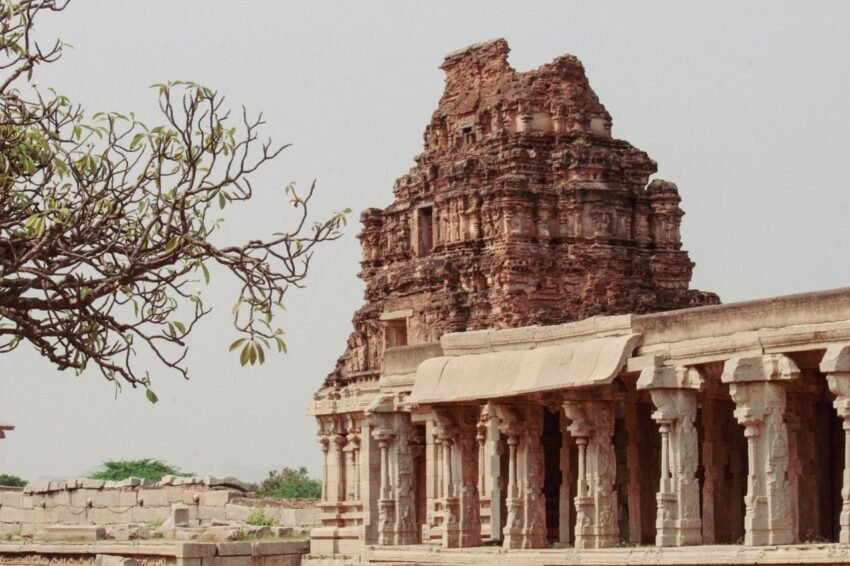
Founded in 1336 CE along the banks of the Tungabhadra River in modern Karnataka, the Vijayanagara Empire arose as a powerful southern realm during a turbulent era of northern invasions. Established by two brothers, Harihara I and Bukka I of the Sangama dynasty, the empire served as a major center of South Indian political power, trade, and cultural patronage for over two centuries.
At its peak, Vijayanagara (“City of Victory”) commanded the vast majority of the Indian peninsula south of the Krishna River, establishing an urban capital at Hampi that foreign travelers described as one of the largest and most prosperous metropolises in the world.
1. Statecraft, Military Innovation, and the Nayankara System
The territorial expansion and resilience of the Vijayanagara state relied on military adaptations, revenue organization, and a decentralized administrative structure.
The Nayankara Administrative System
To rule its sprawling territories, the central imperial crown implemented the Nayankara system, a feudal military framework:
-
Nayakas (Military Governors): The Emperor (Raya) assigned large territories (Arambam) to military commanders called Nayakas.
-
Obligations: In exchange for territorial tax rights, Nayakas maintained fixed contingents of infantry, cavalry, and war elephants for the imperial army and remitted annual revenue to the central treasury.
-
Local Autonomy: Nayakas funded local irrigation projects, fortified towns, and sponsored temple complexes, creating regional pockets of economic growth across South India.
                  THE NAYANKARA REVENUE & MILITARY LOOP
  +-------------------------------------------------------------------+
  | Imperial Crown (Raya) grants land rights (Arambam) to Nayakas.   |
  +-------------------------------------------------------------------+
                                    |
                                    v
  +-------------------------------------------------------------------+
  | Nayakas collect local agricultural taxes & fund public works.      |
  +-------------------------------------------------------------------+
                                    |
                                    v
  +-------------------------------------------------------------------+
  | Nayakas supply central crown with tribute + standing troops.       |
  +-------------------------------------------------------------------+
Trade and Military Innovation
Vijayanagara sat at the center of international maritime trade networks. Through West Coast ports like Mangalore and Cannanore, the empire imported thousands of high-breed Arabian and Persian horses annually to power its elite cavalry.
Foreign travel accounts by Domingo Paes, Fernão Nuniz (Portugal), and Abdur Razzaq (Persia) describe a military state with heavy stone fortifications, state-monopolized iron weaponry, and sophisticated hydraulic management systems built to feed its dense urban population.
2. The Golden Age under Krishnadevaraya (r. 1509–1529 CE)
The reign of Emperor Krishnadevaraya of the Tuluva Dynasty marked the military, economic, and literary zenith of the Vijayanagara Empire.
                      KRISHNADEVARAYA'S REIGN
  +------------------------------------------------------------------+
  | MILITARY CAMPAIGNS                                               |
  | * Decisively defeated the Sultan of Bijapur at Raichur (1520 CE). |
  | * Recaptured the fortress of Udayagiri from the Gajapatis.       |
  | * Maintained strategic dominance over the Deccan Doab.           |
  |------------------------------------------------------------------|
  | LITERARY & CULTURAL PATRONAGE                                    |
  | * Author of the Telugu epic *Amuktamalyada*.                     |
  | * Patronized the *Ashtadiggajas* (8 court poets, e.g., Allasani  |
  |   Peddana and Tenali Ramakrishna).                              |
  +------------------------------------------------------------------+
Krishnadevaraya used royal wealth to build grand monuments, dig irrigation reservoirs like the Rayamudra tank, and grant substantial endowments to major South Indian temple sanctuaries from Tirupati to Chidambaram.
3. Hampi’s Architectural Genius
The capital city of Hampi represents a high point of Dravidian temple architecture, blended with regional Indo-Islamic civil design elements. Spread across a granite landscape, Hampi’s builders carved temples, royal pavilions, and aqueducts directly out of surrounding rock formations.
Architectural Landmarks
-
Virupaksha Temple: Dedicated to Lord Shiva, featuring a towering 50-meter Raya Gopuram (entrance tower) and an intricate hall of carved pillars overlooking the Tungabhadra River.
-
Vithala Temple Complex: Famous for its architectural craftsmanship:
-
Stone Chariot: A sculpted shrine dedicated to Garuda, designed to resemble a ceremonial temple vehicle.
-
Musical Pillars (SaReGaMa Pillars): Monolithic stone columns engineered to resonate at specific musical pitches when lightly struck.
-
-
Mahanavami Dibba: A massive, multi-tiered carved stone platform where the Emperor reviewed military parades, received diplomatic envoys, and celebrated the ten-day Mahanavami (Navratri) festival.
-
Lotus Mahal and Elephant Stables: Showcasing a hybrid Indo-Islamic style, featuring vaulted arches, recessed domes, and plasterwork designed to keep interior spaces cool during summer months.
                   HAMPI URBAN ARCHITECTURAL ZONING
                   +--------------------------------+
                   |     SACRED CENTER (North)      |
                   | Virupaksha, Vithala, Riverfront|
                   +--------------------------------+
                                   |
                                   v
                   +--------------------------------+
                   |     ROYAL CENTER (South)       |
                   | Lotus Mahal, Mahanavami Dibba  |
                   +--------------------------------+
4. Institutional Comparison: Vijayanagara Architecture
| Architectural Feature | Religious / Sacred Center | Secular / Royal Center |
| Primary Material | Monolithic granite stone cut without mortar. | Granite base combined with brick, lime mortar, and plaster. |
| Stylistic Influence | Pure Dravidian style (Kalyana Mandapas, tall Gopurams). | Hybrid Indo-Islamic style (cusped arches, domes, vaulting). |
| Key Purpose | Devotional worship, royal consecration, monastic housing. | Imperial administration, military housing, royal leisure. |
| Signature Example | Vithala Temple, Virupaksha Temple. | Lotus Mahal, Elephant Stables, Royal Enclosure. |
5. The Battle of Talikota and Fall (1565 CE)
After the death of Krishnadevaraya, factional disputes weakened the imperial court. The regent Rama Raya attempted to play the neighboring Deccan Sultanates—Bijapur, Golconda, Ahmadnagar, and Bidar—against one another.
Recognizing Rama Raya’s strategy, the Deccan Sultanates formed a united coalition. On January 23, 1565, the armies met at the Battle of Talikota (Rakkasagi-Tangadagi):
-
The Turning Point: Key mercenary commanders within the Vijayanagara military defected mid-battle, leading to a total rout of the imperial army and the capture of Rama Raya.
-
The Sacking of Hampi: Victorious coalition forces marched into Hampi. The metropolis was systematically looted and burned over six months, leaving behind the granite structural ruins seen today.
While the empire survived in a diminished capacity from new capitals at Penukonda and Chandragiri (under the Aravidu Dynasty), the destruction of Hampi marked the end of Vijayanagara’s era as the dominant empire of South India.
Category: History of India