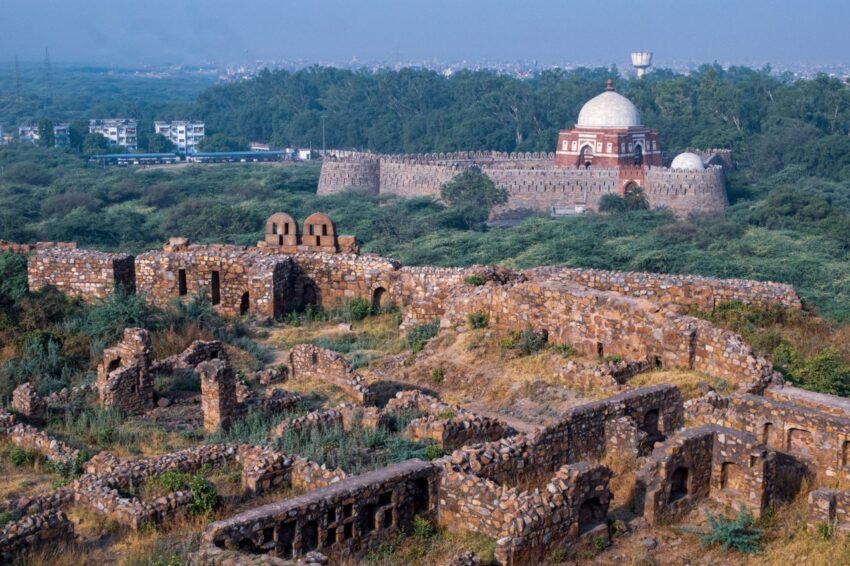
The Tughlaq Dynasty (1320–1413 CE) represented one of the most ambitious yet turbulent epochs of the Delhi Sultanate. Dominating central and northern India during the 14th century, the Tughlaqs expanded the territorial reach of the Sultanate to its maximum physical limit before experiencing rapid disintegration.
Unlike their predecessors, the Tughlaqs attempted radical state engineering: large-scale urban relocations, administrative centralization, monetary innovations, and massive public civil works. These structural interventions were driven by two contrasting monarchs: the visionary yet impractical Muhammad bin Tughlaq (r. 1325–1351) and his pragmatic, builder successor Firuz Shah Tughlaq (r. 1351–1388).
1. Muhammad bin Tughlaq: Strategic Experiments and Fiscal Reforms
Muhammad bin Tughlaq inherited a vast empire that stretched from the Himalayan foothills down to the southern tip of the Deccan. To govern this sprawling territory, he launched three famous administrative experiments that profoundly impacted the Sultanate’s economy and social stability.
A. The Capital Shift to Daulatabad (1327 CE)
Recognizing that Delhi sat too far north to effectively govern the newly annexed southern provinces, Muhammad bin Tughlaq decided to establish a second administrative capital at Devagiri in Maharashtra, renaming it Daulatabad (“Abode of Wealth”).
                      THE CAPITAL SHIFT (1327 CE)
  +----------------------------------------------------------------+
  | RATIONALE                                                      |
  | * Central geographical location within the expanding empire.  |
  | * Better administrative grip over the Deccan and South India.  |
  | * Strategic distance from Mongol invasion corridors in Punjab. |
  +----------------------------------------------------------------+
                                 |
                                 v
  +----------------------------------------------------------------+
  | EXECUTION & CONSEQUENCES                                       |
  | * Ordered complete migration of Delhi's elite and populace.    |
  | * Massive casualties along the 1,500 km trek due to hardship.  |
  | * Exposed northern frontier to Mongol raids during absence.    |
  | * Forced to abandon Daulatabad and return to Delhi in 1335 CE. |
  +----------------------------------------------------------------+
While the move was a short-term logistical disaster that alienated the court elite, it produced a major long-term cultural side effect: it introduced northern Persian and Urdu linguistic traditions to the Deccan, laying the cultural foundations for the later Bahmani Sultanate.
B. The Token Currency Experiment (1329–1330 CE)
Faced with a drain on silver reserves due to imperial expansion and military campaigns, Muhammad bin Tughlaq introduced a token currency system modeled on Yuan-era Chinese paper money (Chao) and Ilkhanid Persian models.
-
Mechanism: The state minted brass and copper coins and decreed their face value equal to high-value silver (Tanka) and gold coins.
-
Structural Failure: The Sultanate failed to establish a state monopoly on minting or implement anti-counterfeiting measures. As contemporary historian Ziauddin Barani recorded, “every house of a Hindu/local metalworker became a private mint.”
-
Economic Collapse: Foreign merchants refused to accept copper tokens for imported goods. Trade ground to a halt, forcing the Sultan to repeal the ordinance and redeem all forged copper tokens with genuine silver coins from the royal treasury, exhausting state finances.
                   TOKEN CURRENCY CRISIS CYCLE
   [Silver Reserves Drop] ---> [Mint Brass/Copper Tokens]
                                        |
                                        v
   [Treasury Emptied]  <--- [Uncontrolled Counterfeiting]
C. Agrarian Reforms and Taxation in the Doab
To offset treasury losses, the Sultan drastically increased land revenues in the fertile Ganga-Yamuna Doab region. The timing coincided with a severe famine. When peasants abandoned their lands to form insurgent bands, the state responded with harsh force.
Realizing his error, Muhammad bin Tughlaq created a dedicated Ministry of Agriculture—Diwan-i-Kohi—which introduced:
-
Sondhar / Taccavi: Direct state agriculture loans for purchasing seeds, digging wells, and clearing farm fields.
-
Crop Rotation Systems: Direct state incentives for farmers to switch from lower-value grains (like barley) to higher-value cash crops (like sugarcane and grapes).
2. Firuz Shah Tughlaq: Public Works and Welfare Infrastructure
Following Muhammad bin Tughlaq’s death in 1351 CE, his cousin Firuz Shah Tughlaq assumed the throne. Shifting away from aggressive territorial expansion, Firuz Shah focused entirely on consolidation, administrative stability, welfare, and monumental civil engineering.
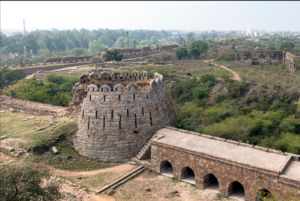
A. The Western Yamuna and Satluj Canal Networks
Firuz Shah is best known as the pioneer of large-scale canal irrigation in medieval India. He constructed an interconnected canal network to transform dry areas in Haryana and Punjab into productive farmland:
-
Rajabwah Canal: Diverted water from the Yamuna River directly to the newly founded city of Hissar-Firoza.
-
Ulughkhani Canal: Channeling water from the Satluj River to feed imperial agricultural lands.
To finance these projects, the state levied a special 10% water tax (Haqq-i-Sharb) on land irrigated by royal canals, creating a sustainable revenue stream while protecting regions from famine.
B. Urbanization, Forts, and Public Welfare
Firuz Shah founded numerous fortified towns and administrative urban centers that survive today, including Firozabad (Kotla Firoz Shah in Delhi), Hissar, Jaunpur (named in honor of Muhammad bin Tughlaq, Jauna Khan), and Firozpur.
                   FIRUZ SHAH DEPARTMENTS & INSTITUTIONS
  +-------------------------------------------------------------------+
  | DEPARTMENT        | FUNCTION                                      |
  |-------------------|-----------------------------------------------|
  | Diwan-i-Bandagan  | Department of Slaves (Managed 180,000 royal   |
  |                   | captives trained in crafts & administration)  |
  | Diwan-i-Khairat   | Public Charity Department (Funded dowries for |
  |                   | impoverished women and supported orphans)     |
  | Dar-ul-Shafa      | Free Public Hospitals (Staffed by state-paid  |
  |                   | physicians providing free medicine)           |
  +-------------------------------------------------------------------+
3. Comparative Institutional Legacy
| Administrative Dimension | Muhammad bin Tughlaq (1325–1351) | Firuz Shah Tughlaq (1351–1388) |
| Imperial Vision | Highly centralized, pan-Indian territorial empire. | Regional consolidation and internal stability. |
| Monetary Strategy | Radical experimentation (Token Currency). | Standardized orthodox silver/copper coinage (Adha, Bikh). |
| Agricultural Policy | Direct state loans (Taccavi) and crop diversification. | Canal irrigation networks and tax incentives. |
| Administrative Style | Theoretical, authoritarian, and uncompromising. | Conciliatory toward nobility, army, and religious orthodoxy. |
4. Historical Impact and Collapse
The Tughlaq era exposed both the possibilities and limits of medieval statecraft. Muhammad bin Tughlaq’s visionary reforms failed due to poor execution and lack of institutional controls. Conversely, while Firuz Shah’s welfare programs and canal engineering improved agrarian productivity, his decision to make army posts and land grants (Iqtas) strictly hereditary weakened the military structure.
Decades after Firuz Shah’s death, the weakened Tughlaq state collapsed under the invasion of Timur (Tamerlane) in 1398 CE, leaving behind an urban and agricultural legacy that shaped northern Indian infrastructure for centuries.
Category: History of India